Louis van Houtte's artists del. · Louis van Houtte, Ghent
Week of 6 July 2026
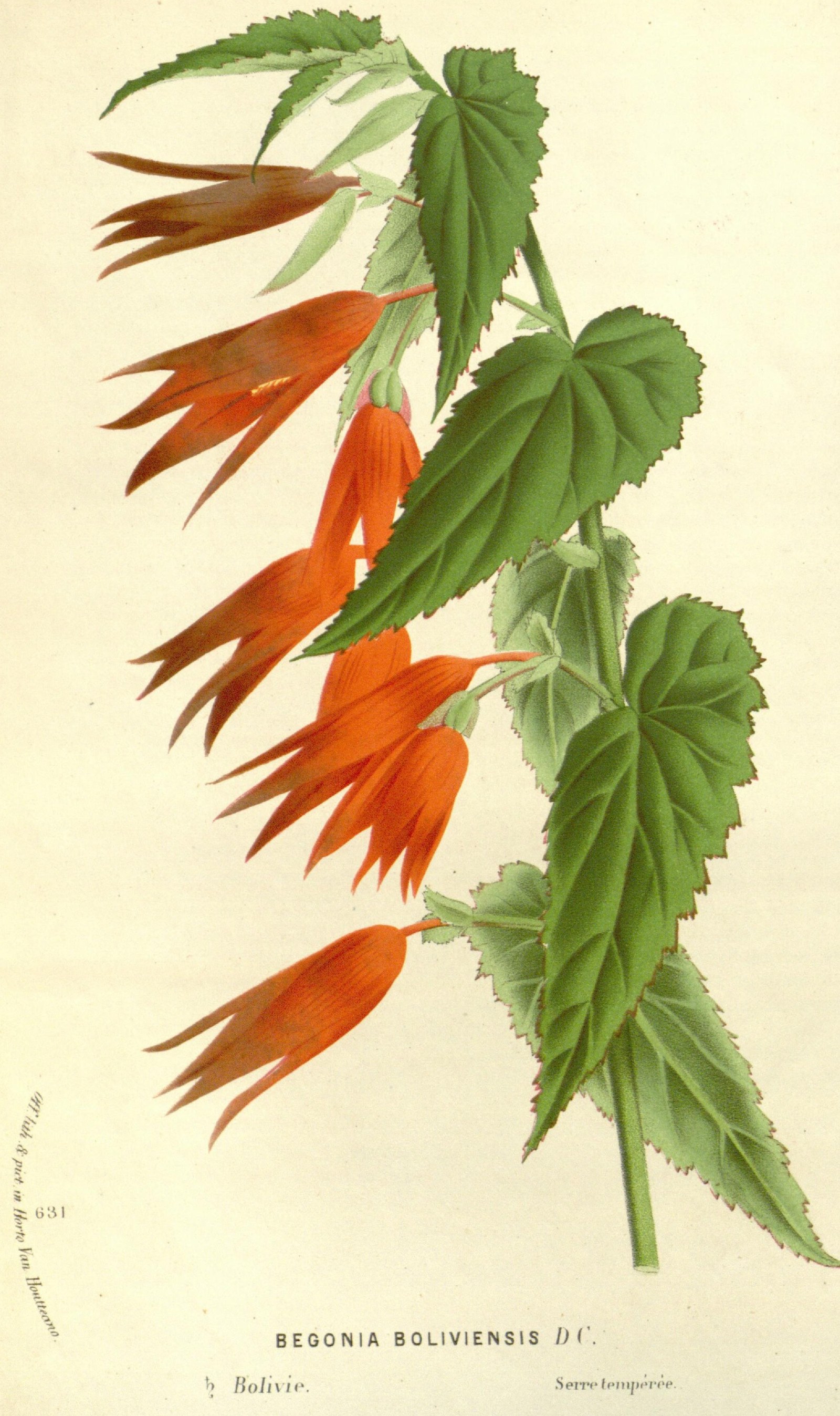
Bolivian begonia
Part 5 of 6 in Van Houtte's Flore des serres
Begonia boliviensis
The scarlet fuchsia-flowered begonia from the Bolivian Andes, shown at Paris in 1867 and figured by van Houtte the same year, the parent of every tuberous begonia in a hanging basket.
- Published
- Plate 1725, volume 17, 1867
- From
- Flore des serres et des jardins de l'Europe
- Drawn by
- Louis van Houtte's artists
- Technique
- Hand-coloured lithograph
- Family
- Begoniaceae
- Native to
- The eastern Andes of Bolivia and Argentina
About the plant
The tuberous begonias that fill hanging baskets and park beds every summer, in every colour from white to crimson, are hybrids less than a hundred and fifty years old, and this is where they began. Begonia boliviensis grows in the cloud forests of the eastern Andes in Bolivia and northern Argentina, a plant with narrow pointed leaves and hanging scarlet flowers more like a fuchsia's than a begonia's, dying back each winter to a tuber. Hugh Weddell found it in 1857, Richard Pearce sent it to the Veitch nursery in 1864, and when it was shown at the Paris Exposition of 1867 it stopped the crowds.
Van Houtte figured it in the Flore des serres the same year, and at Veitch's the hybridist John Seden set about crossing it with the other Andean begonias Pearce had sent home. The first tuberous hybrid, 'Sedenii', flowered in 1870, and within a decade there were doubles, bicolours and giants. Begonia boliviensis itself has come back into fashion lately for its grace, which the hybrids lost.
Bought together
More in the archive