Louis van Houtte's artists del. · Louis van Houtte, Ghent
Week of 22 June 2026
Otaksa hydrangea
Part 3 of 6 in Van Houtte's Flore des serres
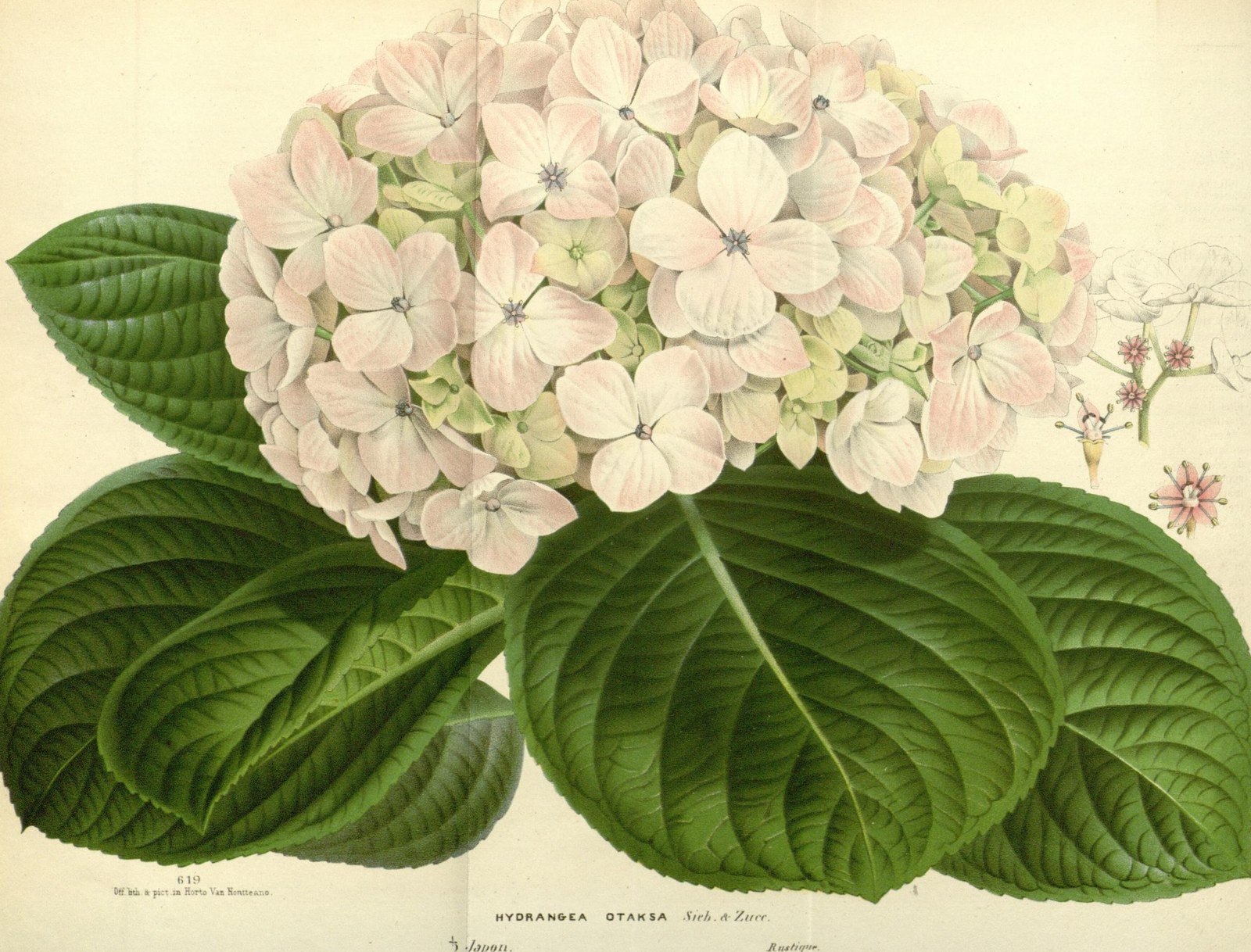
Hydrangea macrophylla 'Otaksa' (published as Hydrangea otaksa)
Von Siebold's Otaksa hydrangea, the mophead of a thousand seaside gardens, named for the woman he left behind in Nagasaki, figured by van Houtte on a double plate.
- Published
- Plate 1752–1753, volume 17, 1867
- From
- Flore des serres et des jardins de l'Europe
- Drawn by
- Louis van Houtte's artists
- Technique
- Hand-coloured lithograph
- Family
- Hydrangeaceae
- Native to
- A Japanese garden form of a hydrangea of the coasts of Japan
About the plant
Philipp Franz von Siebold spent six years in Japan as physician to the Dutch trading post at Nagasaki, and when he was expelled in 1829 for possessing maps he had to leave behind the woman he lived with, Kusumoto Taki, and their small daughter. Among the plants he carried to Europe was a hydrangea from the gardens of Nagasaki, a form of the wild hydrangea of the Japanese sea cliffs with great domed heads of sterile florets, and in 1840 he named it Hydrangea otaksa, for Otaki-san, as he had called her. Botanists have since sunk the name, but the plant is still Otaksa in the nurseries, and its story has outlived its Latin.
It is the mophead of the English seaside garden, the hydrangea that turns blue in the acid soils of Cornwall and pink on the chalk, that flowers for months and takes salt wind and neglect without complaint; most of the mophead cultivars of the last century descend from it. Van Houtte gave it a double plate in the Flore des serres in 1867, a flowering branch at natural size across two pages, with the florets shading from green to rose.
Bought together
More in the archive