Louis van Houtte's artists del. · Louis van Houtte, Ghent
Week of 29 June 2026
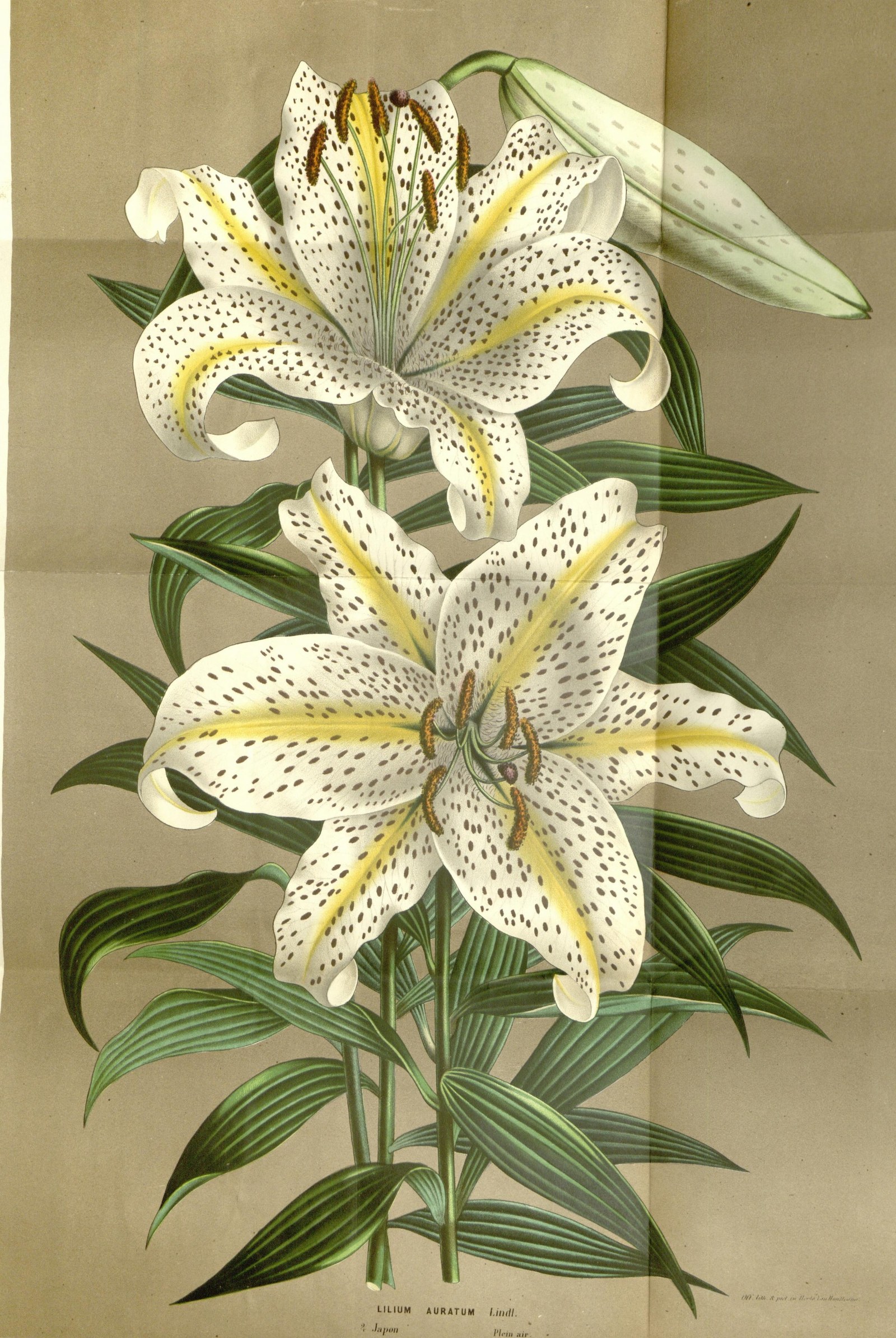
Golden-rayed lily of Japan
Part 4 of 6 in Van Houtte's Flore des serres
Lilium auratum
The golden-rayed lily that stopped the show when it first flowered in England in 1862, given a double fold-out plate by Louis van Houtte in the Flore des serres.
- Published
- Plate 1528–1531, volume 15, 1863
- From
- Flore des serres et des jardins de l'Europe
- Drawn by
- Louis van Houtte's artists
- Technique
- Hand-coloured lithograph
- Family
- Liliaceae
- Native to
- Honshu, Japan
About the plant
Louis van Houtte was the greatest nurseryman in Europe, with glasshouses at Ghent that covered acres and a catalogue that ran to thousands of plants, and from 1845 to 1880 he published his own magazine to advertise them: the Flore des serres et des jardins de l'Europe, twenty-three volumes and more than two thousand hand-coloured lithographs of everything new that his collectors sent home and his nursery sold. When the golden-rayed lily of Japan arrived in 1862 he gave it the largest plate the magazine ever carried, a fold-out across four pages, with a flowering stem at natural size.
The lily had been grown in Japan for centuries, as much for its edible bulb as for the flower, but it was unknown in the West until Japan opened in the 1850s. John Gould Veitch sent bulbs to his family's nursery in Chelsea in 1862, and the first to flower, shown at the Royal Horticultural Society in July, drew crowds: flowers nearly a foot across, white, each petal with a band of gold down its centre and spotted crimson, and a scent that filled the tent. It became the lily of the Victorian conservatory, imported from Japan by the million bulbs a year, and with Lilium speciosum the parent of the oriental hybrids that are the lilies of the florist's shop today.
Bought together
More in the archive