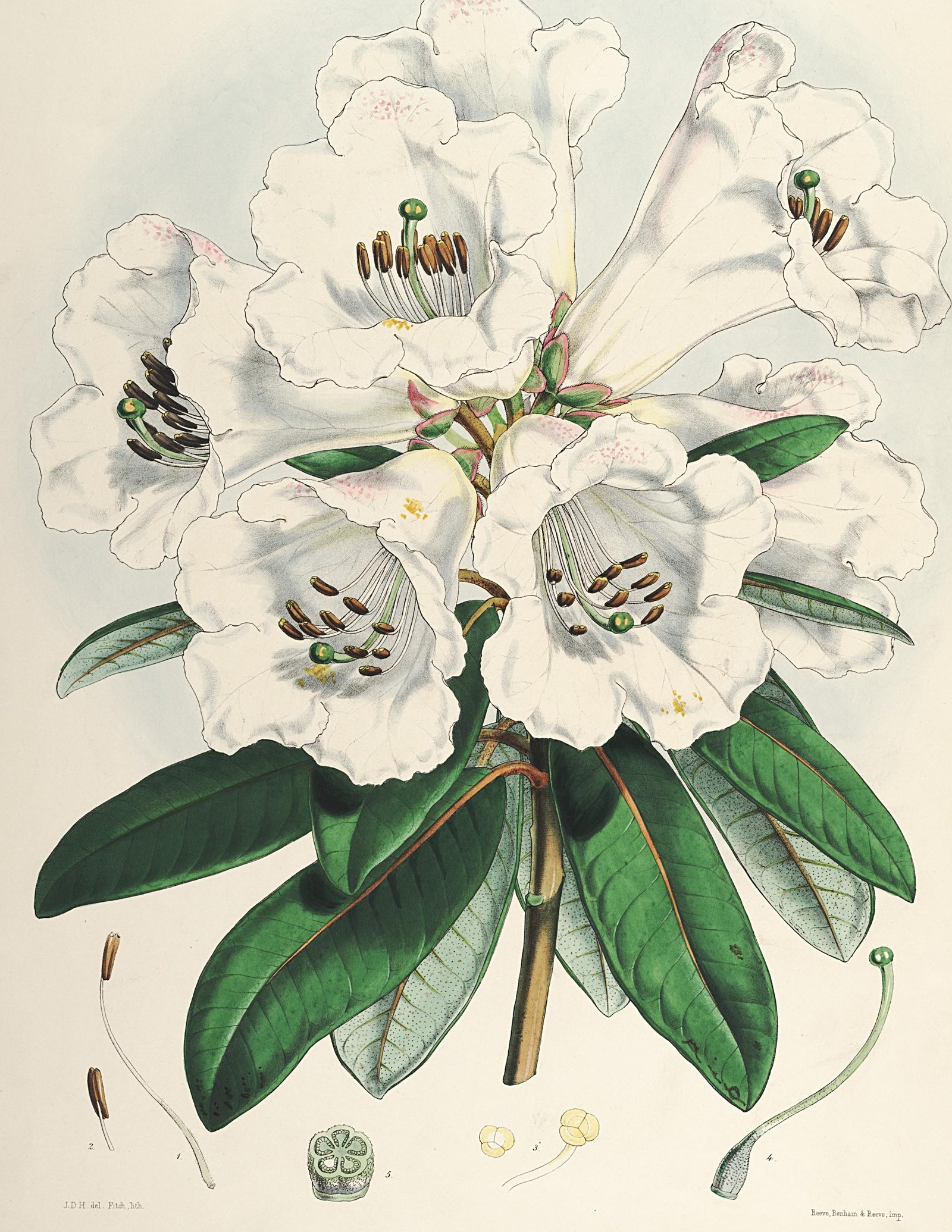
Joseph Dalton Hooker del. · Walter Hood Fitch lith. · Reeve, Benham & Reeve, London
Week of 16 March 2026
Lady Dalhousie's rhododendron
Part 2 of 7 in Rhododendrons and magnolias of the Himalaya
Rhododendron dalhousiae
The first plate of the book that started the rhododendron craze: a tree-dwelling rhododendron with lemon-scented flowers the size of lilies, found by Joseph Hooker in Sikkim in 1848.
- Published
- Plate I, 1849
- From
- The Rhododendrons of Sikkim-Himalaya
- Drawn by
- Joseph Dalton Hooker
- Lithograph
- Walter Hood Fitch
- Technique
- Hand-coloured lithograph
- Family
- Ericaceae
- Native to
- Sikkim and Bhutan, eastern Himalaya
About the plant
In 1848 Joseph Hooker, thirty-one years old and already the veteran of an Antarctic voyage, walked into the mountains of Sikkim and found rhododendrons such as nobody in Europe had imagined: trees of them, forests of them, and in the wet forest at seven thousand feet this one, growing not in the ground but in the moss on the limbs of oaks, with flowers like white lilies that smelt of lemon. He named it for Lady Dalhousie, the botanically minded wife of the Governor-General who had seen him off from Calcutta, and sent his sketches home to Kew.
His father, Sir William Hooker, had them lithographed by Walter Fitch and published in parts as The Rhododendrons of Sikkim-Himalaya from 1849, with Joseph's letters as text, while Joseph was still in the mountains, at one point a prisoner of the Raja of Sikkim. The book, and the seed that followed it, started the rhododendron mania that filled the woodland gardens of Victorian Britain. Rhododendron dalhousiae was its first plate, and the plant it shows is still grown in Cornwall and in cool conservatories, where it flowers in May.
Bought together
More in the archive