William Jackson Hooker del. · Joseph Swan sculp. · Samuel Curtis, London
Week of 3 February 2025
Butterfly orchid
Part 1 of 9 in Orchid mania
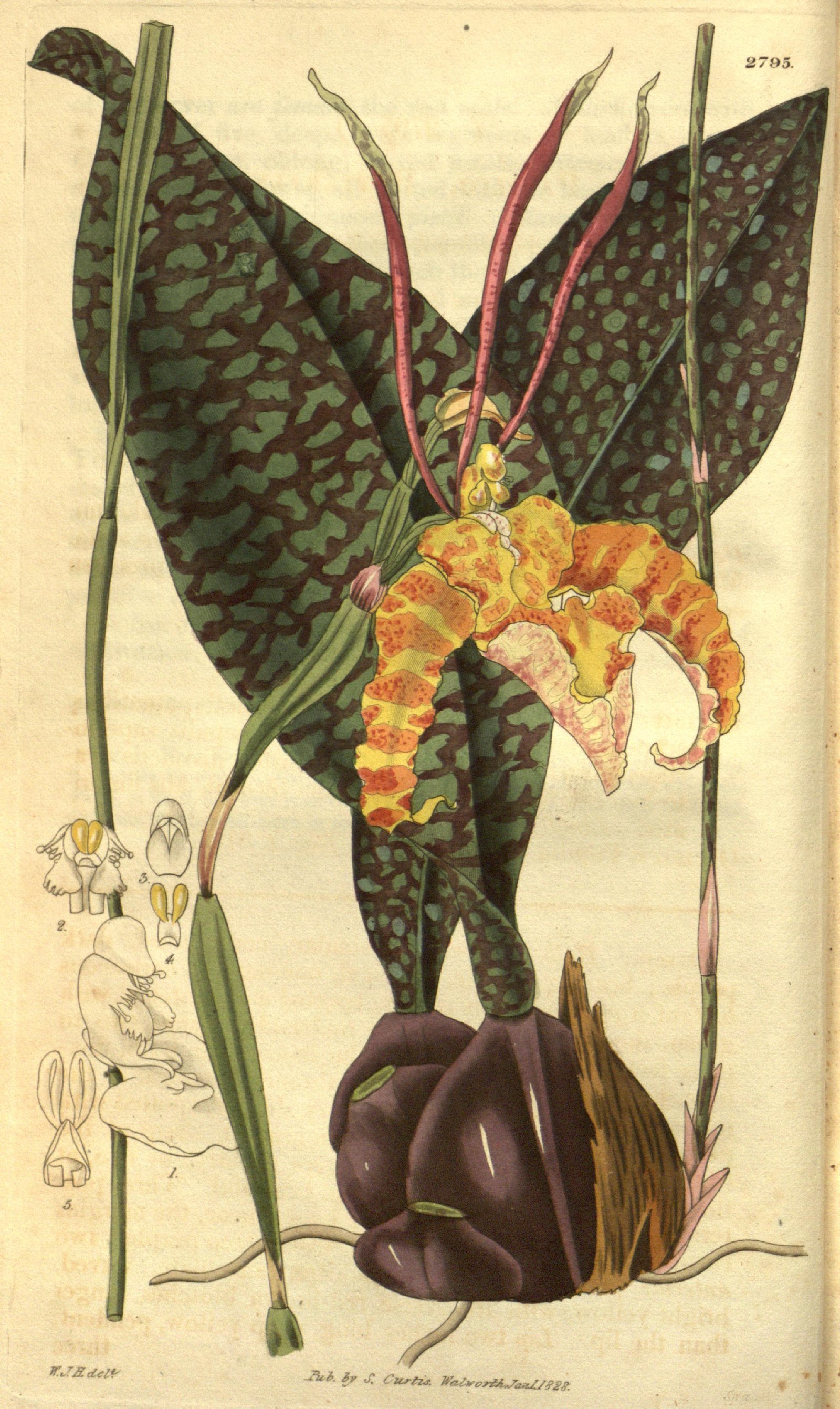
Psychopsis papilio (published as Oncidium papilio)
The orchid that started orchid mania: a flower like a butterfly in flight, which so enchanted the Duke of Devonshire in 1833 that he began the greatest orchid collection of the age.
- Published
- Plate 2795, volume 55, 1828
- From
- Curtis's Botanical Magazine
- Drawn by
- William Jackson Hooker
- Engraved by
- Joseph Swan
- Technique
- Hand-coloured copper engraving
- Family
- Orchidaceae
- Native to
- Trinidad and northern South America
About the plant
This is the flower that launched a craze. A single bloom, 12 cm across, opens at the top of a wiry stem a metre long: three narrow chocolate-and-yellow segments stand up like antennae, two broader ones spread like wings, and a yellow lip with a brown border makes the body. It sways in the slightest draught and looks for all the world like a butterfly resting on a stalk. The 6th Duke of Devonshire saw one at a London exhibition in 1833, bought it on the spot, and set his young gardener Joseph Paxton to building the orchid houses at Chatsworth that made orchid collecting the obsession of the Victorian rich.
The species grows on trees in Trinidad and the forests of northern South America. Each stem produces its flowers one after another over several years, so experienced growers never cut a spike that has finished. John Lindley named it Oncidium papilio in 1825, and it kept that name until the 1970s, when it and a handful of relatives were given their own genus, Psychopsis, 'butterfly-like'.
William Jackson Hooker, then professor at Glasgow and soon to be Kew's first director, drew the plate himself in 1828 for the Magazine he had just taken over, and Joseph Swan engraved it.
Bought together
More in the archive