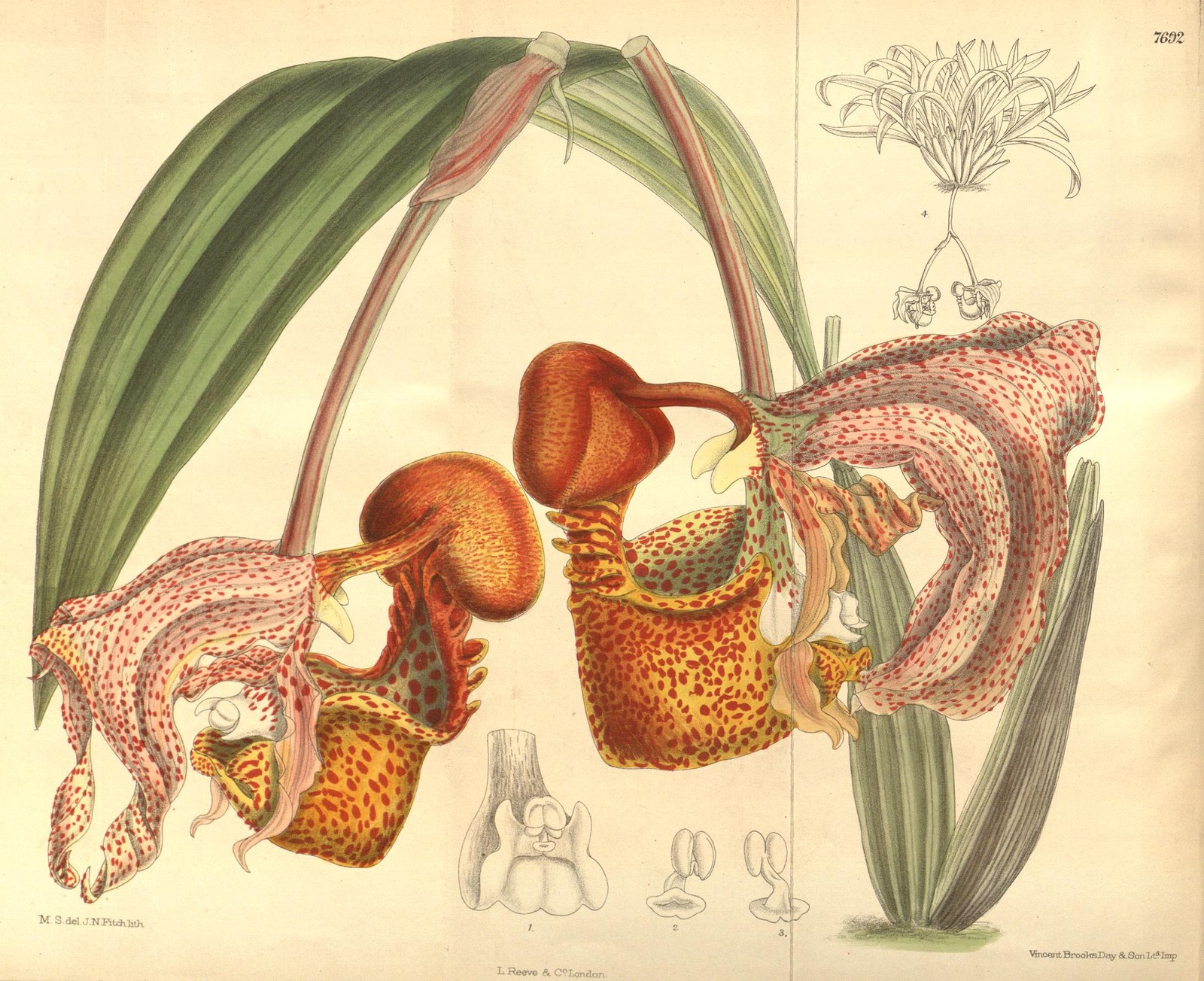
Matilda Smith del. · John Nugent Fitch lith. · Vincent Brooks, Day & Son Ltd · L. Reeve & Co., London
Week of 10 March 2025
Bucket orchid
Part 6 of 9 in Orchid mania
Coryanthes macrantha
The bucket orchid, whose flower drowns a bee in perfume and lets it escape only past the pollen: the most elaborate trap in the orchid world, admired by Darwin.
- Published
- Plate 7692, volume 126, 1900
- From
- Curtis's Botanical Magazine
- Drawn by
- Matilda Smith
- Lithograph
- John Nugent Fitch
- Technique
- Hand-coloured lithograph
- Family
- Orchidaceae
- Native to
- Trinidad and northern South America
About the plant
No flower goes to greater lengths to be pollinated. The lip of a bucket orchid is a fleshy pail, and above it two glands drip liquid until the pail is half full. Male orchid bees arrive to scrape perfume from the waxy surface of the flower, scent they will use to court females, and in their eagerness they lose their footing and fall in. Their wings are soaked and useless; the walls are too slippery to climb. The one escape is a narrow tunnel at the back of the bucket, and as the bee squeezes through, the flower clamps it for a minute while it glues two pollen masses to its back. The next flower the bee falls into takes them off.
Charles Darwin described all this in his 1862 book on the fertilisation of orchids, from the observations of Hermann Crüger, director of the botanic garden in Trinidad, and used it as proof that the most improbable structures could be shaped by selection. In the wild the orchid grows almost always in the nests of tree ants, which defend it and whose refuse feeds it.
Matilda Smith's plate of 1900 shows the flower, as big as a hand, hanging on its stem; the whole performance lasts about three days before it collapses.
Bought together
More in the archive