William Jackson Hooker del. · Joseph Swan sculp. · Samuel Curtis, London
Week of 4 May 2026
Cut-leaf banksia
Part 2 of 6 in Flowering shrubs
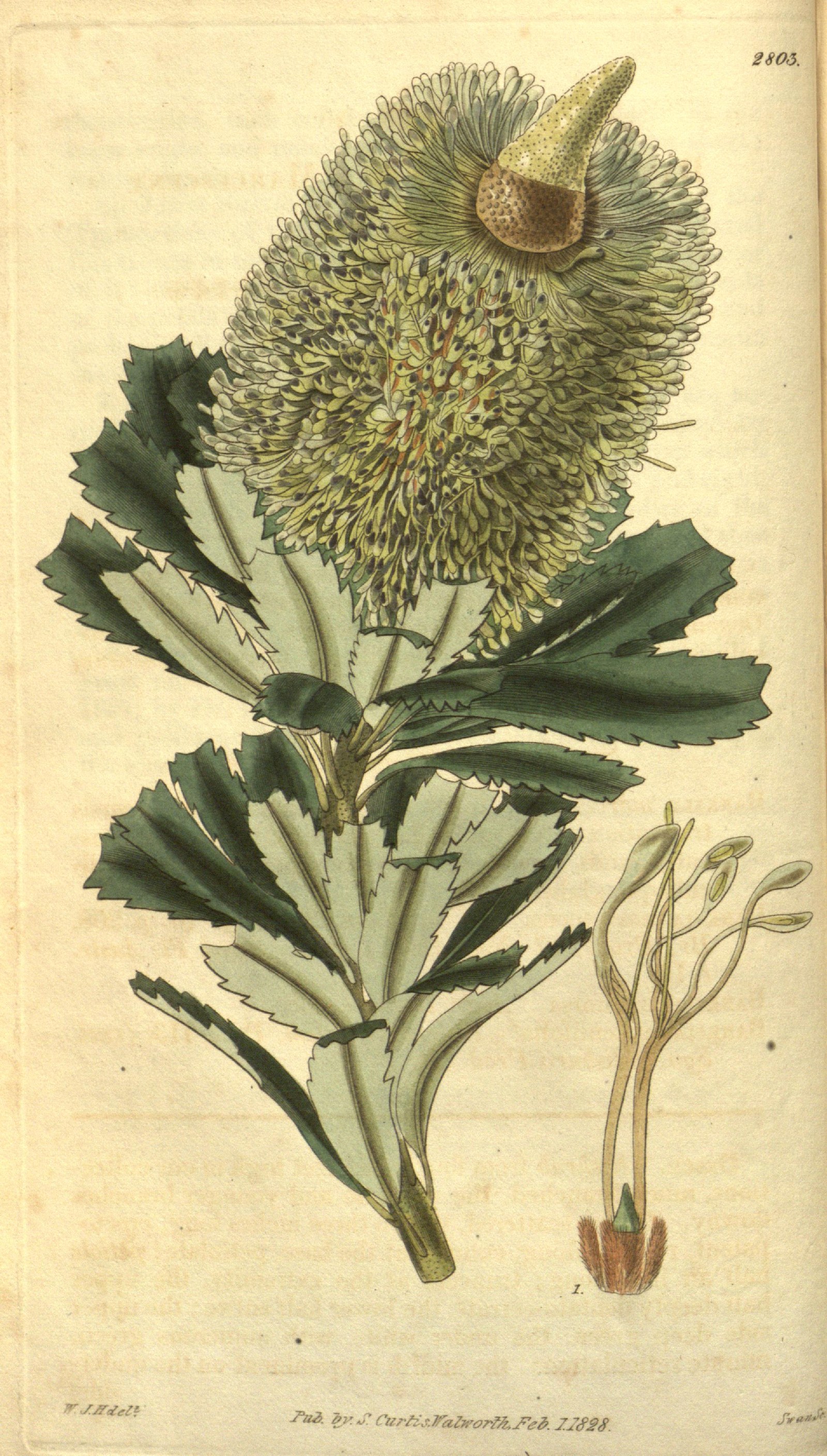
Banksia praemorsa (published as Banksia marcescens)
A banksia from the granite coast around Albany, with leaves that look bitten off at the tip and flower spikes of yellow or wine-red, drawn by W. J. Hooker in 1828.
- Published
- Plate 2803, volume 55, 1828
- From
- Curtis's Botanical Magazine
- Drawn by
- William Jackson Hooker
- Engraved by
- Joseph Swan
- Technique
- Hand-coloured copper engraving
- Family
- Proteaceae
- Native to
- South coast of Western Australia
About the plant
Joseph Banks collected the first banksias at Botany Bay in April 1770, and the genus named for him has become the signature of the Australian bush: shrubs and small trees with stiff, serrated leaves and flower spikes like bottle brushes, packed with hundreds of flowers that open from the bottom up. Banksia praemorsa grows on the granite coast around Albany, where it makes a dense shrub several metres high. Its leaves end as if someone had bitten the tips off, which is what the name means, and its spikes, up to 27 cm tall, may be lemon-yellow or the colour of claret.
The old flowers brown and stay on the cone, which gave the plant the earlier name 'marcescens', withering but persisting, under which this plate was published. Beneath them the seeds wait in woody follicles that open only in the heat of a bushfire, releasing them onto ash where no competitor survives. Honeyeaters and the tiny honey possum feed on the nectar.
William Jackson Hooker drew the plant in 1828 from a specimen flowered in England, in the first year of his editorship, and Joseph Swan engraved it.
Bought together
More in the archive