Ferdinand Bauer del. · James Sowerby sculp. · Richard Taylor for the executors of John Sibthorp, London
Week of 26 August 2024
Myrtle
Part 3 of 6 in The plants of Greece
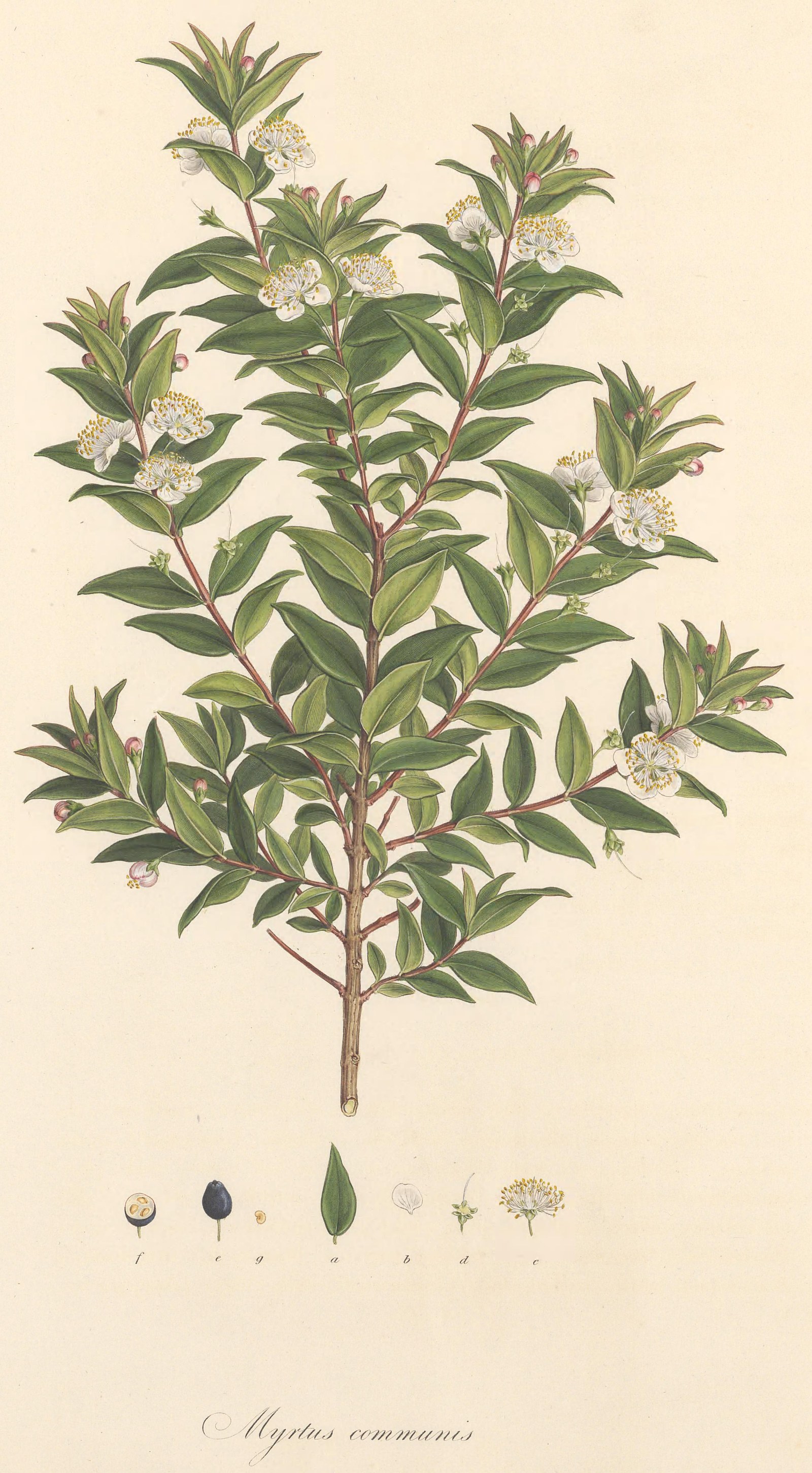
Myrtus communis
The myrtle of Aphrodite and of every royal wedding bouquet since 1858, drawn from the wild shrubs of Greece by Ferdinand Bauer for Flora Graeca.
- Published
- Plate 475, volume 5, 1825
- From
- Flora Graeca
- Drawn by
- Ferdinand Bauer
- Engraved by
- James Sowerby
- Technique
- Hand-coloured copper engraving
- Family
- Myrtaceae
- Native to
- The Mediterranean, North Africa and western Asia
About the plant
Myrtle grows all round the Mediterranean in the scrub of the hills and the edges of woods, a neat evergreen shrub with small glossy leaves that smell of spice when crushed, white flowers in June with a puff of long stamens, and berries that ripen to blue-black in autumn. It is the only wild member in Europe of the great southern family that includes the eucalyptus, the clove and the guava. Bauer drew a flowering branch with the berries beside it, and Smith's text in the fifth volume of Flora Graeca, published in 1825, placed it under the Greek name Dioscorides had used.
No plant has carried more good wishes. The Greeks gave it to Aphrodite and the Romans to Venus, brides wore it in their hair in Athens and Rome and still do in Greek villages, and in 1845 Queen Victoria was given a sprig by Prince Albert's grandmother and planted it at Osborne on the Isle of Wight. A cutting from that bush has gone into the bouquet of every royal bride in Britain since the Princess Royal's wedding in 1858. In Sardinia the berries are steeped in spirit for mirto, the liqueur drunk at the end of every meal, and in Roman kitchens the leaves went into the pot with the pork.
Bought together
More in the archive