Ferdinand Bauer del. · James Sowerby sculp. · Richard Taylor for the executors of John Sibthorp, London
Week of 19 August 2024
Caper
Part 2 of 6 in The plants of Greece
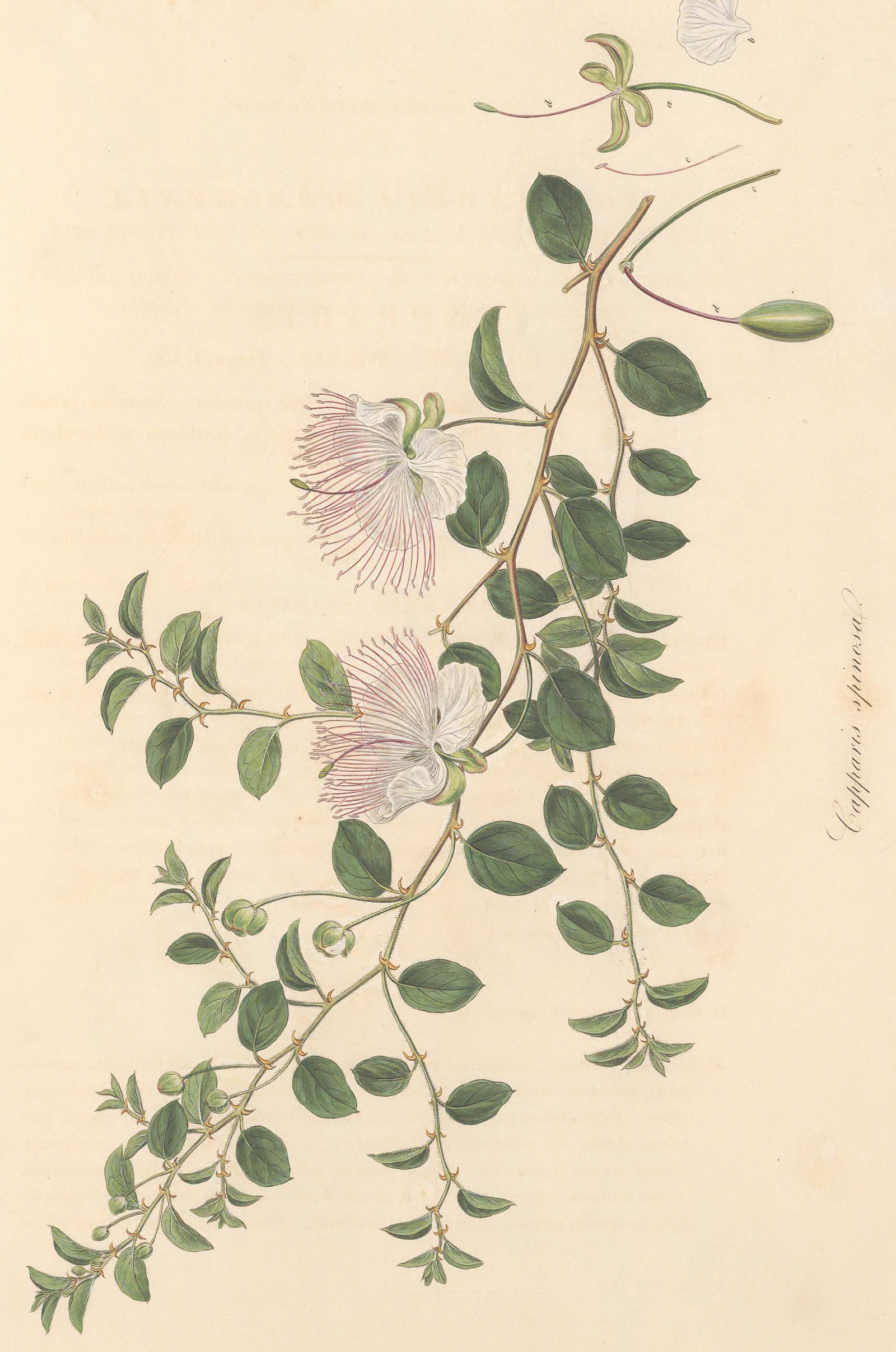
Capparis spinosa
The caper bush of the Mediterranean cliffs, its buds pickled for the table since the Bronze Age, drawn by Ferdinand Bauer with the extravagant white flower that opens for a single morning.
- Published
- Plate 486, volume 5, 1825
- From
- Flora Graeca
- Drawn by
- Ferdinand Bauer
- Engraved by
- James Sowerby
- Technique
- Hand-coloured copper engraving
- Family
- Capparaceae
- Native to
- The Mediterranean and the Middle East, east to Central Asia
About the plant
The caper bush grows where almost nothing else will: out of the mortar of old walls, from cracks in sea cliffs and the baked rock of the Greek islands, trailing its round grey-green leaves down the stone and opening, each dawn through the summer, flowers of four white petals and a brush of long violet stamens that have collapsed by the afternoon. Bauer drew it in 1787 with flowers, buds and the hooked spines at each leaf base that give it its name. The plate was published in 1825 in the fifth volume of Flora Graeca, nearly thirty years after Sibthorp's death.
Nobody eats the flower. The caper of the kitchen is the bud, picked before it opens and salted or pickled, when the mustard oils that the bruised plant releases turn it sharp and savoury; the caperberry is the young fruit pickled on its stalk. Both have been gathered for thousands of years, and the smaller the bud the higher the price. The plant was in the pharmacopoeias too, as a diuretic and for the liver, and in Ecclesiastes the failing of the caper is one of the signs that a man has grown old.
Bought together
More in the archive