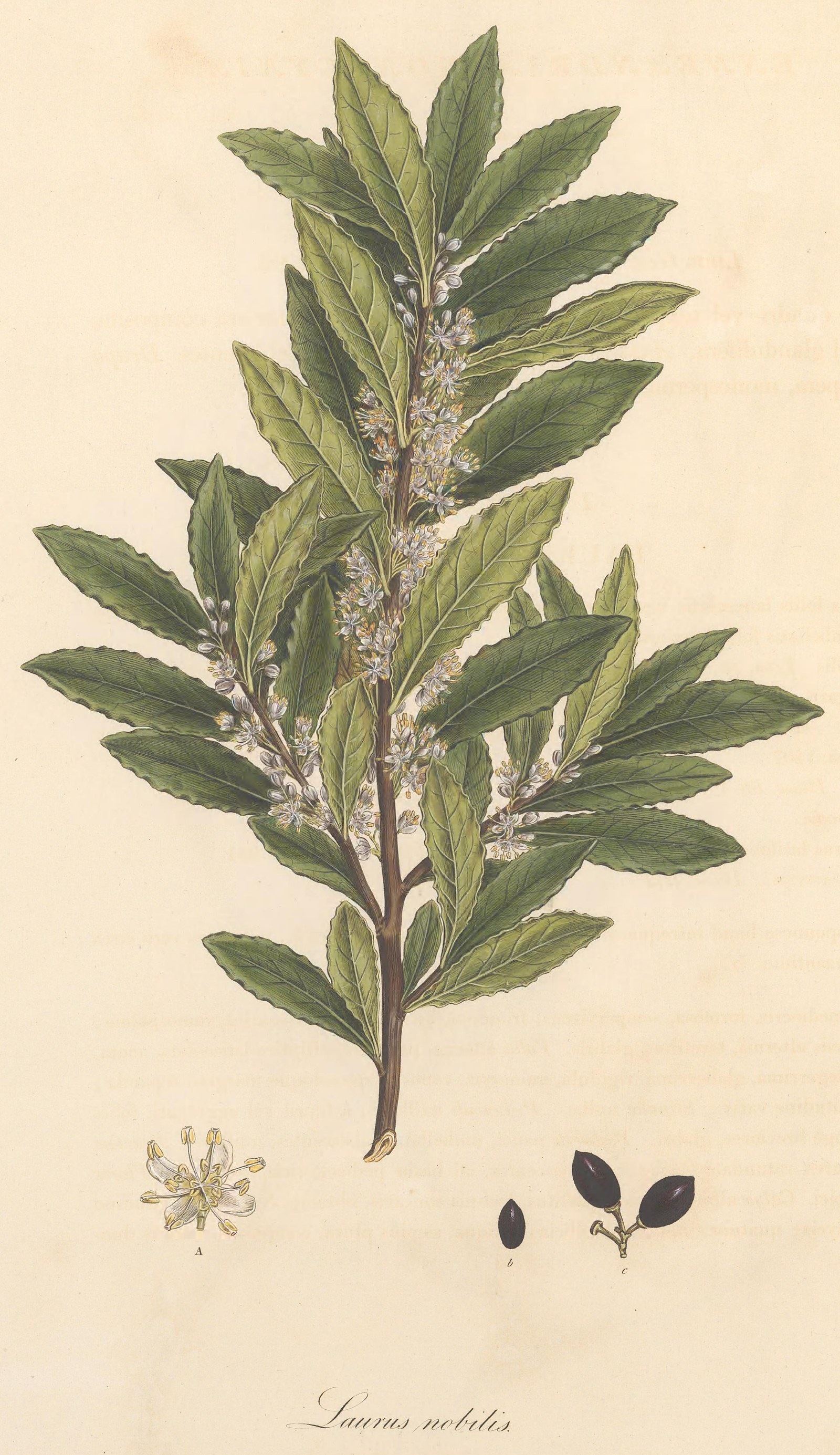
Ferdinand Bauer del. · James Sowerby sculp. · Richard Taylor for the executors of John Sibthorp, London
Week of 2 September 2024
Bay laurel
Part 4 of 6 in The plants of Greece
Laurus nobilis
The laurel of Apollo and of the kitchen, the tree that crowned Greek victors and still flavours every stock pot, drawn from the wild trees of Greece for Flora Graeca.
- Published
- Plate 365, volume 4, 1823
- From
- Flora Graeca
- Drawn by
- Ferdinand Bauer
- Engraved by
- James Sowerby
- Technique
- Hand-coloured copper engraving
- Family
- Lauraceae
- Native to
- The eastern Mediterranean
About the plant
Laurus nobilis is the true laurel, the noble laurel of the Greeks, a slow evergreen tree of the eastern Mediterranean that grows wild in the gorges of Greece and Turkey and in gardens everywhere else. Its leaves, dark and glossy and spiced when crushed, were sacred to Apollo: the priestess at Delphi chewed them, the victors at the Pythian games were crowned with them, and Roman generals wore them in triumph. From the Greek and Latin for a laurel crown come the poet laureate and the baccalaureate, the berry of the laurel. Ovid tells how it began, with the nymph Daphne turning into the tree as Apollo caught her.
Bauer drew a flowering branch of a male tree with its clusters of small yellow flowers, and added the black berries that only the female bears. It is a plant of the kitchen as much as of the myths. A bay leaf in a stew or a stock, or in the milk for a rice pudding, is so ordinary a thing that it is easy to forget it is the same leaf; the dried leaf keeps its scent for a year. It is the family of cinnamon, camphor, sassafras and the avocado, the Lauraceae, aromatic trees of warm climates of which the bay is the only one hardy enough to grow outdoors in a northern garden.