Ferdinand Bauer del. · James Sowerby sculp. · Richard Taylor for the executors of John Sibthorp, London
Week of 12 August 2024
Olive
Part 1 of 6 in The plants of Greece
Olea europaea
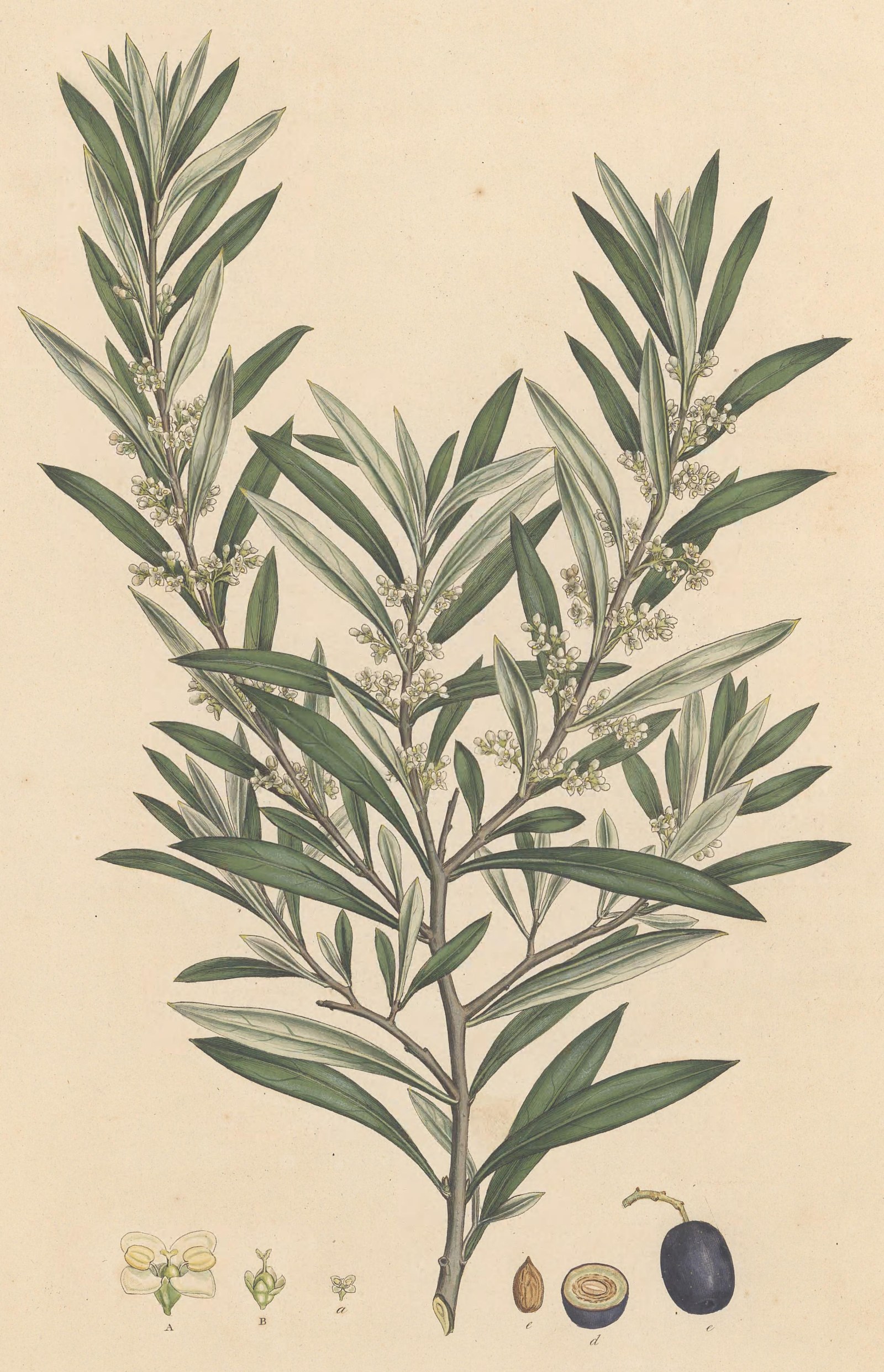
The olive of the Greek hills, drawn by Ferdinand Bauer for the third plate of Flora Graeca, the most expensive botanical book ever published.
- Published
- Plate 3, volume 1, 1806
- From
- Flora Graeca
- Drawn by
- Ferdinand Bauer
- Engraved by
- James Sowerby
- Technique
- Hand-coloured copper engraving
- Family
- Oleaceae
- Native to
- The Mediterranean basin
About the plant
John Sibthorp, the young Sherardian Professor of Botany at Oxford, set out for Greece in 1786 to find the plants Dioscorides had described seventeen centuries before, and took with him the Austrian painter Ferdinand Bauer. For a year they travelled through the Aegean, Cyprus and Asia Minor, Bauer sketching in pencil and marking each part of each plant with a number from a colour chart of a thousand shades, so that he could paint the finished watercolours years later in Oxford without a specimen. Sibthorp died of consumption in 1796, leaving his estate to publish the results. Flora Graeca took from 1806 to 1840, ran to ten folio volumes and 966 plates, and was printed for about twenty-five subscribers at a price that made it the most expensive flora ever issued.
The olive was the third plate. Bauer drew a fruiting branch with the flowers and the black ripe drupes, the tree that made Greece's economy then as now. The olive was domesticated in the eastern Mediterranean at least six thousand years ago from the wild oleaster, and the cultivated tree has gone back to the hills to grow wild again wherever it was planted. It is slow, and it is very nearly immortal: cut to the ground, burnt or struck by frost, it sprouts again from the base, and trees of a thousand years and more are known around the Mediterranean.
Bought together
More in the archive