Pierre-Joseph Redouté del. · Crapelet, Paris
Week of 30 March 2026
Lily magnolia
Part 4 of 7 in Rhododendrons and magnolias of the Himalaya
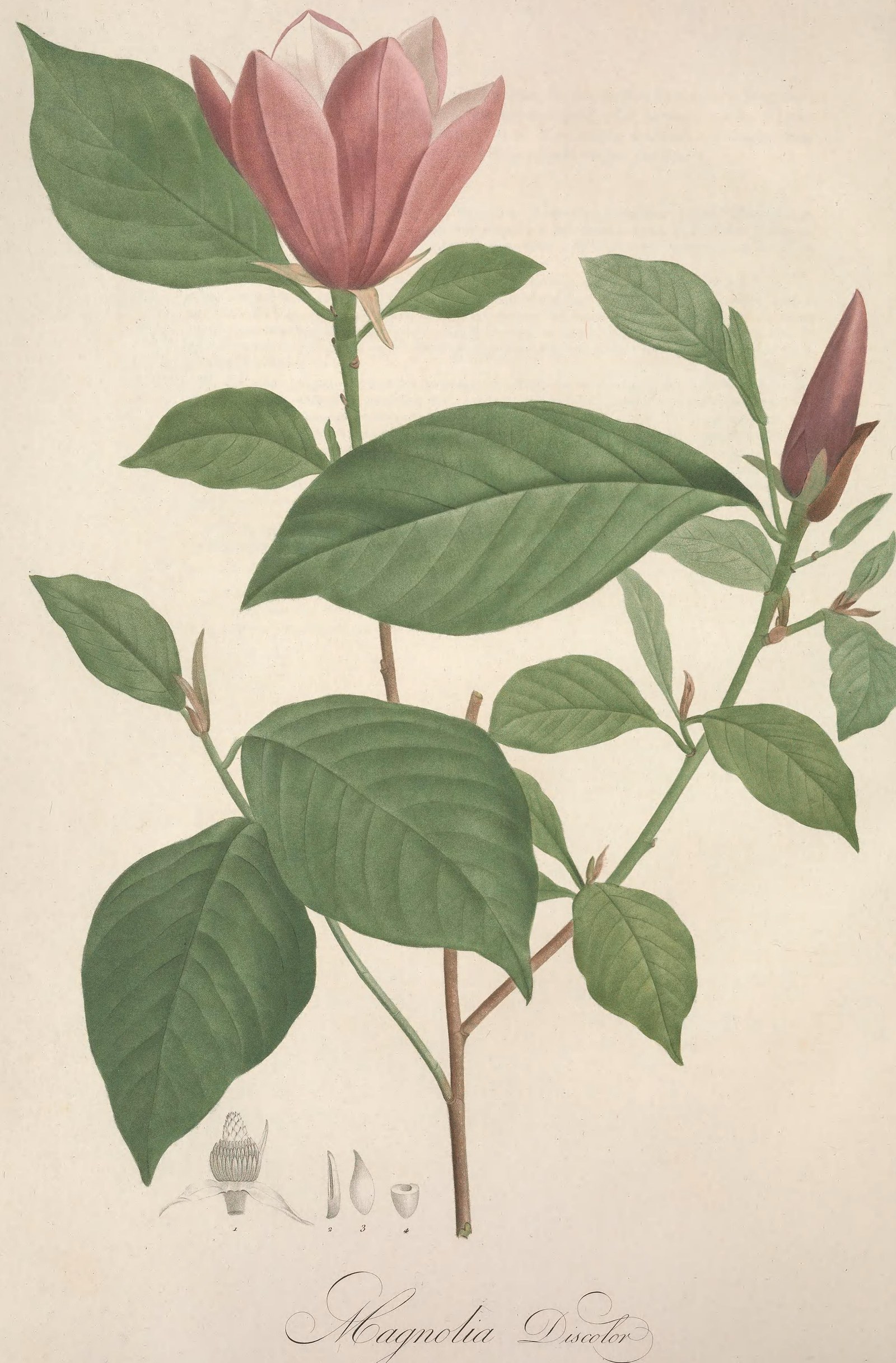
Magnolia liliiflora (published as Magnolia discolor)
The purple lily magnolia of Chinese gardens, one of the first to flower in France, painted by Redouté from the Empress Josephine's plant for Ventenat's Jardin de la Malmaison.
- Published
- Plate 24, 1803
- From
- Jardin de la Malmaison
- Drawn by
- Pierre-Joseph Redouté
- Technique
- Colour-printed stipple engraving, finished by hand
- Family
- Magnoliaceae
- Native to
- China; long cultivated in Japan
About the plant
Josephine Bonaparte bought the château of Malmaison west of Paris in 1799 and spent the rest of her life, and a great deal of Napoleon's money, filling its grounds with plants that nobody in France had grown before, from the Cape, from Australia and from China, under the care of the botanist Étienne Pierre Ventenat. Jardin de la Malmaison, published in twenty parts between 1803 and 1805, was the record: 120 plates by Redouté of the rarest of her plants, with Ventenat's descriptions. This magnolia, which he named Magnolia discolor for its two-coloured petals, flowered at Malmaison when it was still a rarity anywhere in Europe.
It is the lily magnolia of Chinese gardens, grown there since the Tang dynasty and in Japan for centuries, a shrub rather than a tree, whose narrow upright flowers are dark purple outside and white within and open with the leaves in spring. It came to England from Japan in 1790, and twenty years after this plate a retired cavalry officer, Étienne Soulange-Bodin, crossed it at Fromont near Paris with the white Yulan magnolia of China and produced Magnolia × soulangeana, the saucer magnolia, which is now the commonest magnolia in the world's gardens. Redouté drew the Malmaison plant in flower with a cross-section of the fruit.
Bought together
More in the archive