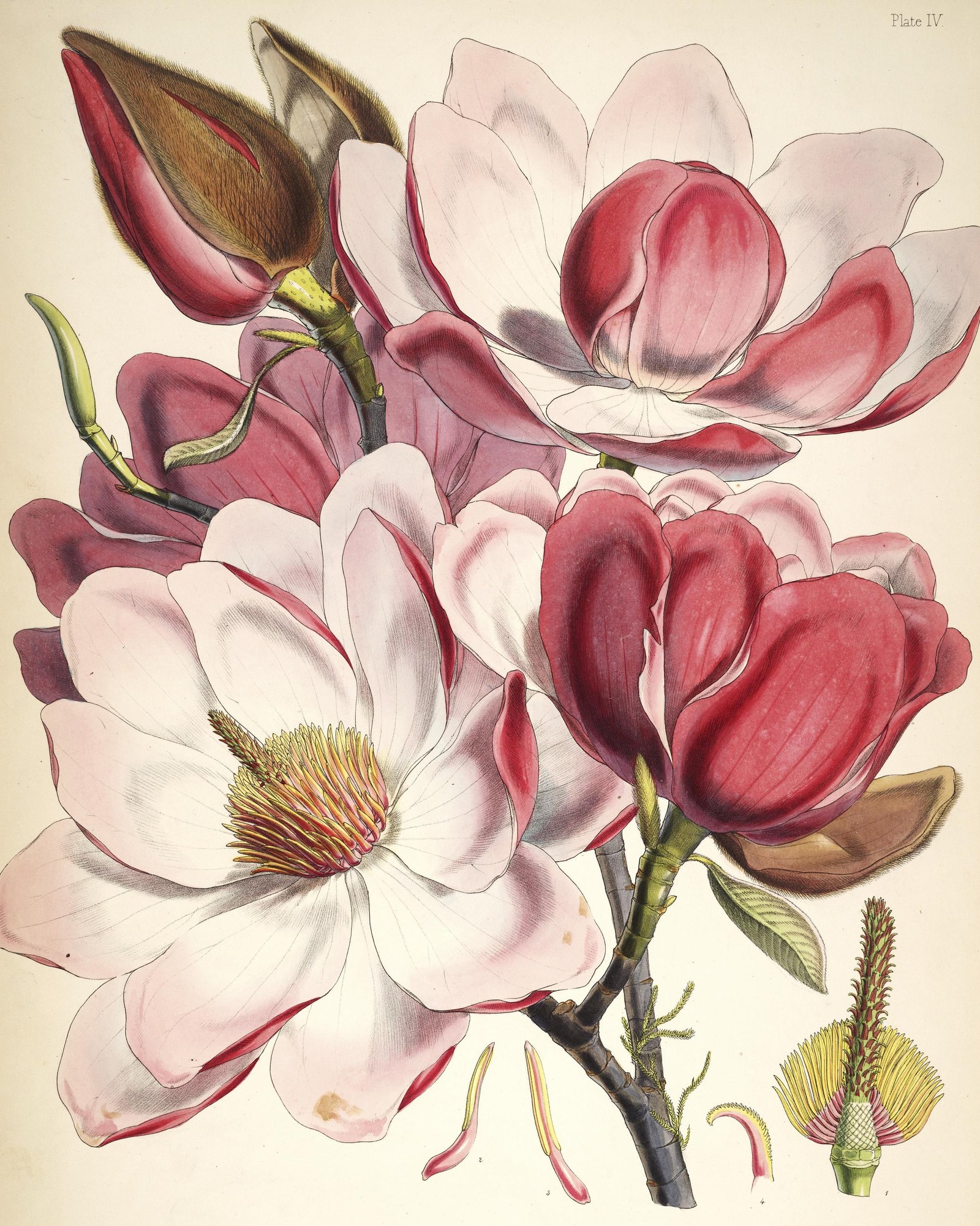
Walter Hood Fitch del. et lith. · Lovell Reeve, London
Week of 9 March 2026
Campbell's magnolia
Part 1 of 7 in Rhododendrons and magnolias of the Himalaya
Magnolia campbellii
The pink tulip tree of the Himalaya, which flowers on bare branches in March with blooms a foot across, drawn from Cathcart's Indian artists for Hooker's Illustrations of Himalayan Plants.
- Published
- Plate IV, 1855
- From
- Illustrations of Himalayan Plants
- Drawn by
- Walter Hood Fitch
- Lithograph
- Walter Hood Fitch
- Technique
- Hand-coloured lithograph
- Family
- Magnoliaceae
- Native to
- Eastern Himalaya from Nepal to Yunnan
About the plant
In the forests above Darjeeling, at seven to nine thousand feet, there are trees that in March, before a leaf has opened, cover themselves with pink flowers the size of a dinner plate, each opening flat into a saucer with an inner cup, so that a whole hillside looks lit from within. Hooker saw them in 1848 and named the tree for Archibald Campbell, the East India Company's agent at Darjeeling, who travelled with him into Sikkim and shared his imprisonment there in 1849. It is the grandest of the magnolias and the slowest: a tree grown from seed will stand for a quarter of a century before it flowers, which is why the first to bloom in Britain did so in the 1880s and why a mature Campbell's magnolia in a Cornish garden is an inheritance.
The plate is from Illustrations of Himalayan Plants, a folio that Hooker put together in 1855 from a remarkable source: the drawings made at Darjeeling by Indian artists in the employ of John Ferguson Cathcart, a Bengal judge and amateur botanist who died in 1851. Hooker chose twenty-four of their paintings and had Fitch lithograph them, giving the artists, whose names Cathcart never recorded, their only monument.
Bought together
More in the archive