Frederick Edward Hulme del. · Cassell & Company, London
Week of 6 May 2024
Honeysuckle
Part 5 of 6 in Wild flowers of the hedgerow
Lonicera periclymenum
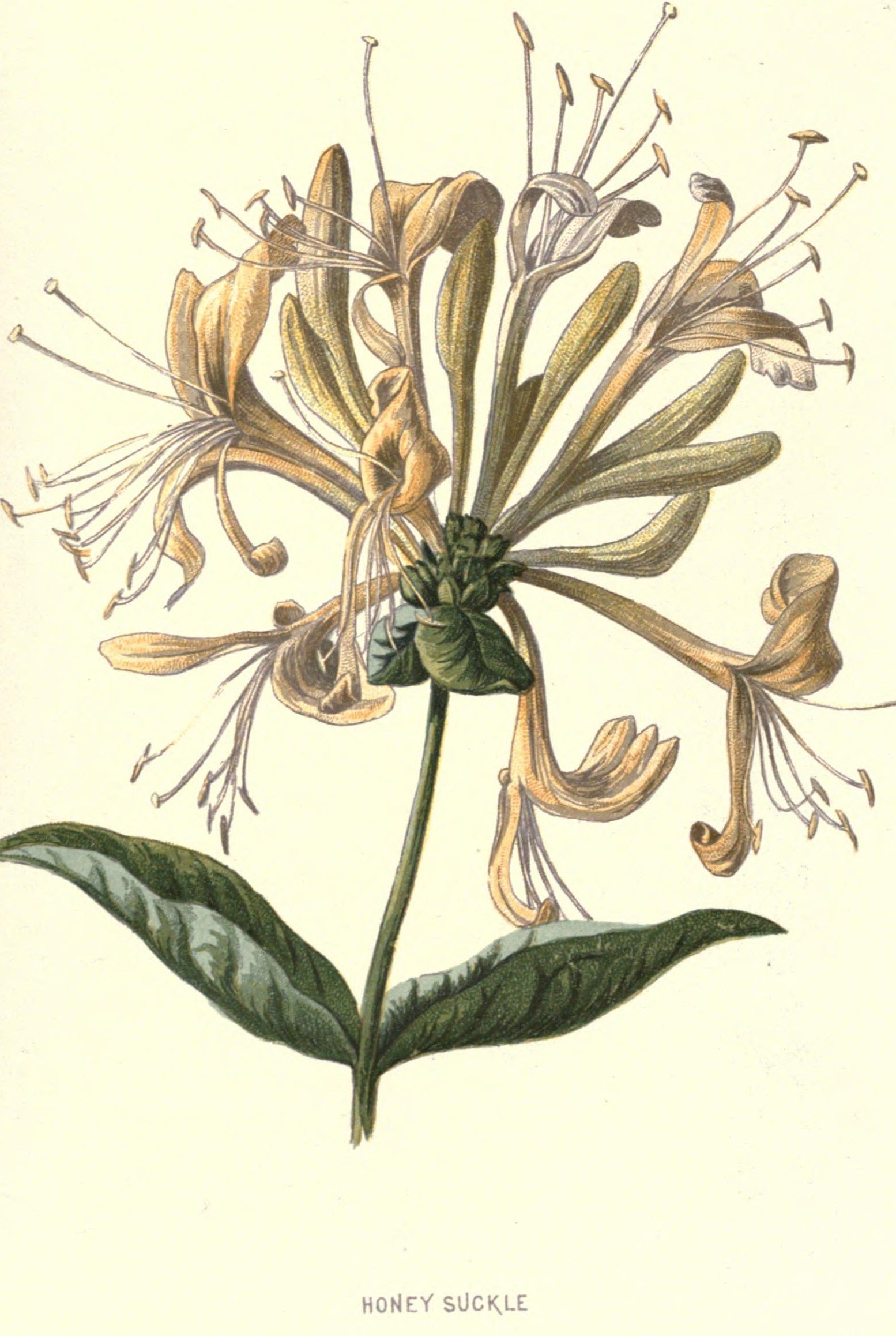
The woodbine of the hedgerow, scented at dusk for the moths that pollinate it, drawn by F. E. Hulme for the second series of Familiar Wild Flowers.
- Published
- volume 2, 1879
- From
- Familiar Wild Flowers
- Drawn by
- Frederick Edward Hulme
- Technique
- Chromolithograph
- Family
- Caprifoliaceae
- Native to
- Britain, Ireland and western Europe
About the plant
Honeysuckle climbs through every old hedge in Britain, twining clockwise up the hazel and the thorn, and in June and July hangs its whorls of long-tubed flowers, cream flushed with red, that open at evening and pour out their scent at dusk. The scent is for the moths: the tube is too long for a bee to reach the nectar, and it is the hawkmoths, hovering in the half-dark, that pollinate it. A flower that has been visited turns from cream to yellow, a signal to the next moth not to waste its time. The berries that follow in autumn are red and glassy, food for thrushes and warblers and not for people.
It was Shakespeare's woodbine, the climber that roofed Titania's bower, and the plant that country people cut their walking sticks from, hazel rods that the honeysuckle had twisted into corkscrews. Hulme drew it with the flowers at every stage from bud to turned yellow, and gave it a plate in the second series of Familiar Wild Flowers in 1879, the book that went on through five series and was never out of print in his lifetime.