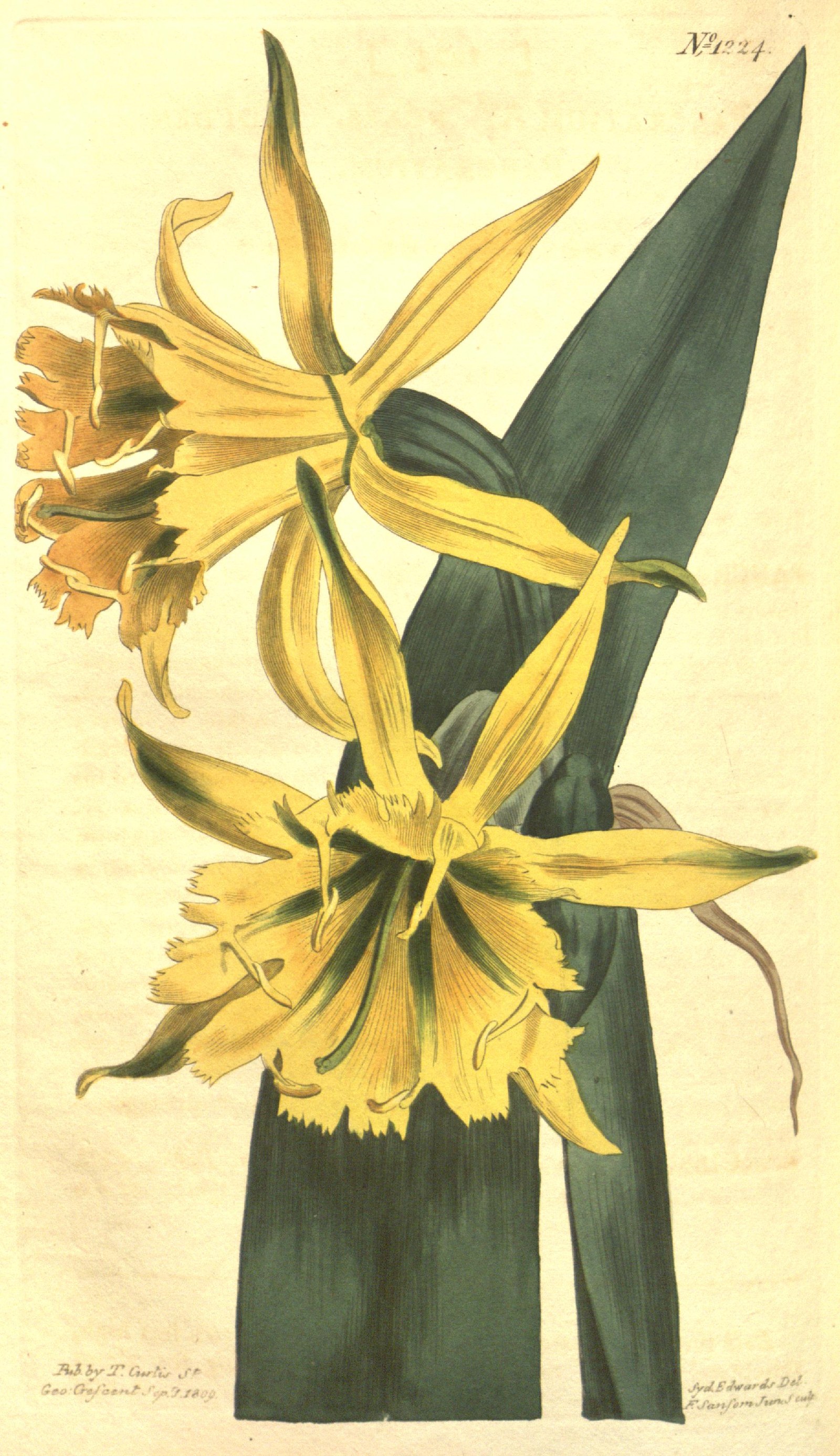
Sydenham Edwards del. · Francis Sansom sculp. · Samuel Curtis, London
Week of 11 August 2025
Amancay
Part 1 of 6 in Bulbs and irises
Ismene amancaes (published as Pancratium amancaes)
Lima's own flower: a golden daffodil-like bulb that blooms when the winter fog greens the hills above the city, drawn by Sydenham Edwards in 1809.
- Published
- Plate 1224, volume 30, 1809
- From
- Curtis's Botanical Magazine
- Drawn by
- Sydenham Edwards
- Engraved by
- Francis Sansom
- Technique
- Hand-coloured copper engraving
- Family
- Amaryllidaceae
- Native to
- The fog-fed hills above Lima, Peru
About the plant
For most of the year the hills around Lima are bare brown desert, because it almost never rains. Then, from June, the winter fog rolls in off the cold Pacific and the slopes turn green for a few months with plants that live on mist alone. Among them is the amancay: a bulb that throws up a sheaf of strap leaves and golden-yellow flowers shaped like a daffodil, with a wide cup striped green and joined to the stamens by a frill. The Pampa de Amancaes above the city was named for its drifts of them, and from colonial times until the twentieth century Lima went up the hill on 24 June, the feast of St John, to picnic, dance and pick armfuls.
The city has since climbed the hills itself, and the flower that gave the district its name survives in a few protected patches of fog oasis. Bulbs reached England early: this plate of 1809 shows the first to flower here, under the name Pancratium amancaes, drawn by Sydenham Edwards, who drew almost every plate the Magazine published in its first thirty years.
The Spanish word amancay is Quechua in origin and in Argentina and Chile is now given to quite different flowers.
Bought together
More in the archive