Walter Hood Fitch del. et lith. · Lovell Reeve, London
Week of 3 November 2025
Channelled echeveria
Part 1 of 6 in Desert plants and living fossils
Echeveria canaliculata
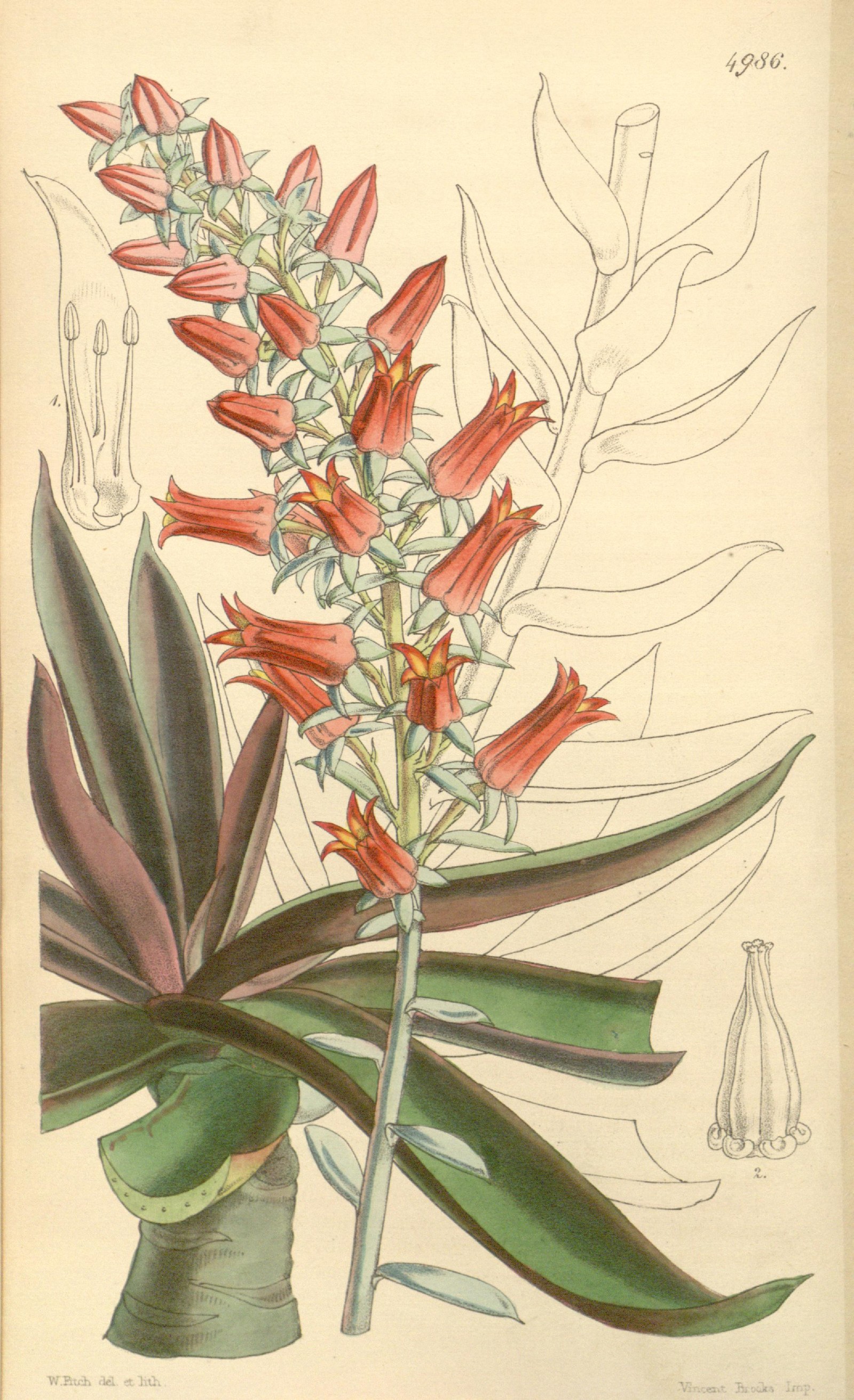
A Mexican echeveria with channelled, red-edged leaves and arching sprays of coral bells, drawn by Fitch when it flowered at Kew in 1857.
- Published
- Plate 4986, volume 83, 1857
- From
- Curtis's Botanical Magazine
- Drawn by
- Walter Hood Fitch
- Lithograph
- Walter Hood Fitch
- Technique
- Hand-coloured lithograph
- Family
- Crassulaceae
- Native to
- Mexico
About the plant
Echeverias are the rosette succulents that now fill every garden centre, and this is one of the first to reach Europe. It grows on cliffs in the mountains of southern Mexico, a loose rosette of spoon-shaped leaves, each grooved down its length and tinged red at the margin, from which rise arching stems hung with coral-red bells. In Mexico the bells are tended by hummingbirds; in a Kew greenhouse in 1857 they were drawn by Walter Hood Fitch for this plate.
The genus honours Atanasio Echeverría y Godoy, one of the artists who travelled with the Spanish Royal Botanical Expedition through Mexico between 1787 and 1803, painting thousands of plants whose drawings then lay unpublished in Madrid for a century. Like other succulents, echeverias keep their pores shut by day and open them in the cool of night to take in carbon dioxide, which is how they survive on sun-baked rock with hardly any water.
The plant has since been found to be a relative of the much-grown Echeveria gibbiflora, and its frilled, coloured hybrids descend in part from plants like this one.
Bought together
More in the archive