Elizabeth Blackwell del. · Samuel Harding, London
Week of 23 December 2024
Arabica coffee
Part 1 of 6 in Blackwell's Curious Herbal
Coffea arabica
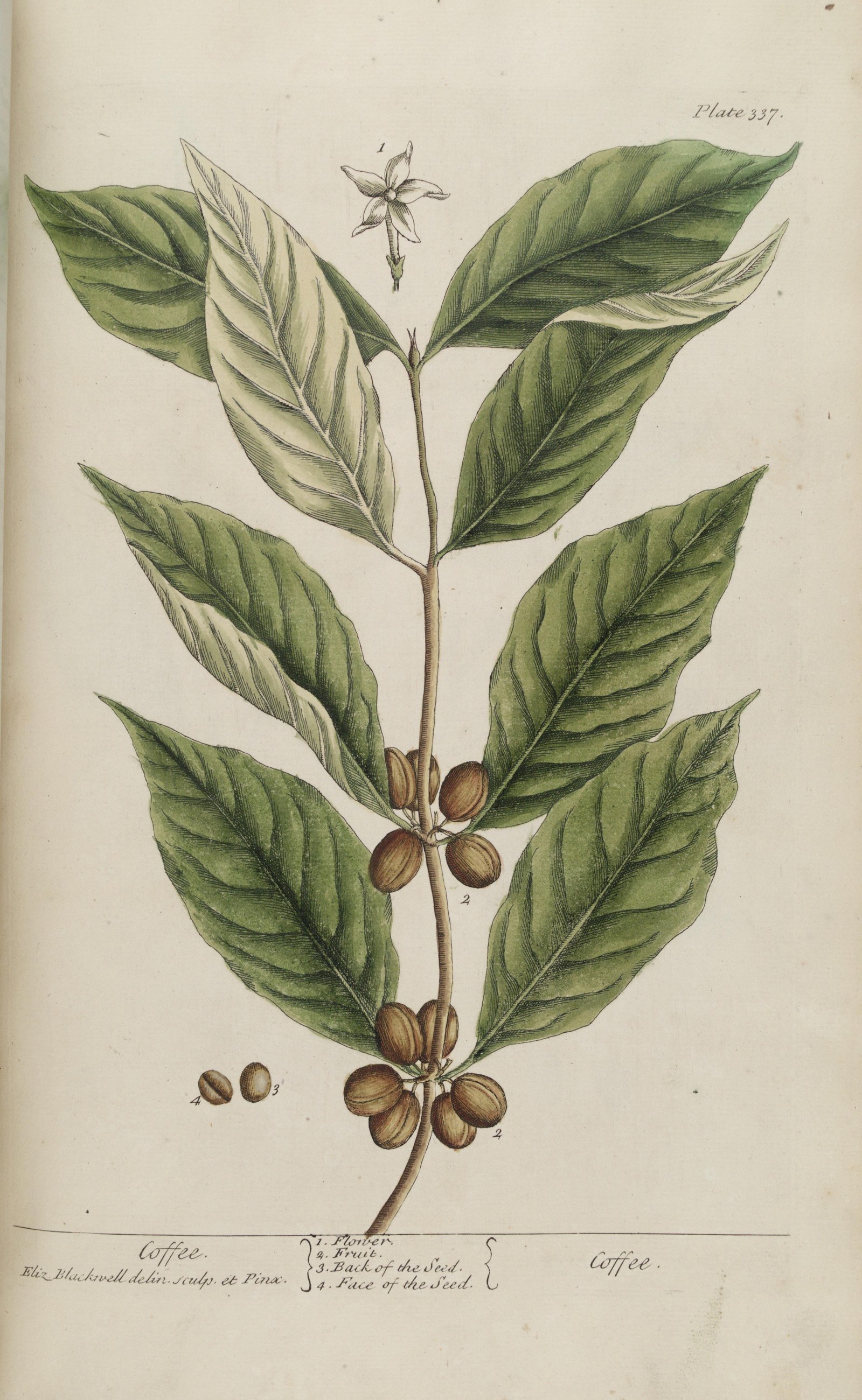
The coffee shrub with its jasmine-scented flowers and red cherries, drawn, engraved and coloured by Elizabeth Blackwell in 1739, when London had been drinking coffee for ninety years and the plant itself was a rarity under glass.
- Published
- Plate 337, volume 2, 1739
- From
- A Curious Herbal
- Drawn by
- Elizabeth Blackwell
- Technique
- Hand-coloured copper engraving
- Family
- Rubiaceae
- Native to
- Highlands of Ethiopia and South Sudan
About the plant
Coffee is a shrub of the Ethiopian forest, an evergreen with glossy leaves and, after rain, a sudden flush of white flowers scented like jasmine that last only a day or two. The fruits that follow redden over eight months and hold two seeds apiece, and those seeds, fermented, dried and roasted, are the bean. The drink was first brewed in Yemen in the fifteenth century, by Sufi mystics who used it to stay awake for their devotions, and it crossed to Mecca, Cairo and Constantinople before a Venetian merchant brought it to Europe in 1615. London's first coffeehouse opened in 1652, and the next century was argued over coffee.
Linnaeus named the plant in 1753, fourteen years after this plate. Elizabeth Blackwell drew it in 1739 for the second volume of A Curious Herbal, the book she made to pay her husband's debts and get him out of debtors' prison: five hundred plates drawn from living plants, most of them in the Chelsea Physic Garden near her lodgings, engraved on copper by her own hand and coloured by her too, with the uses of each plant set beside it. Coffee had been drunk in London since the 1650s, but the tree was still a rarity in England, raised under glass from seed sent from Amsterdam, and most of her readers had never seen the flowers or the cherries that she shows.
Bought together
More in the archive