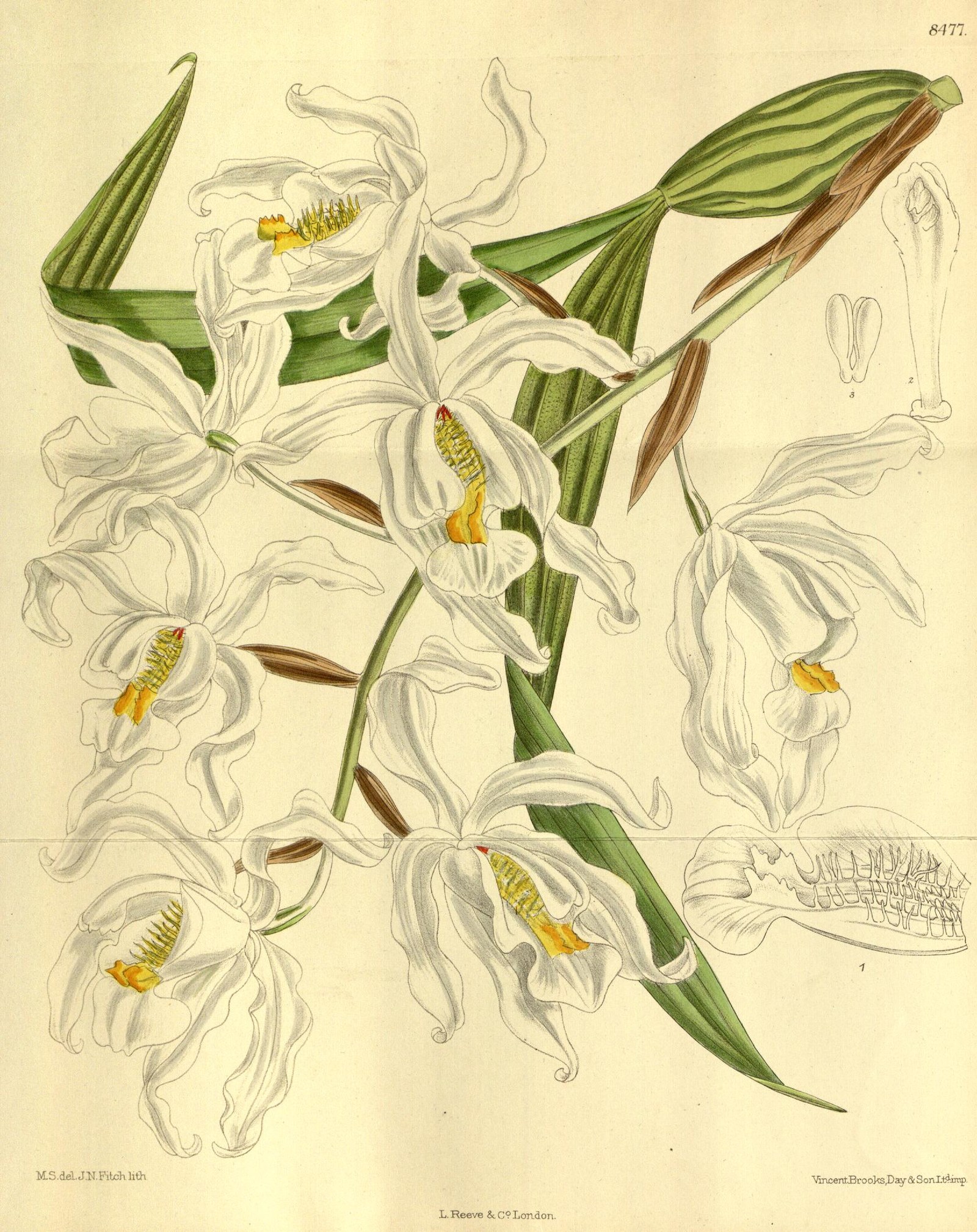
Matilda Smith del. · John Nugent Fitch lith. · Vincent Brooks, Day & Son Ltd · L. Reeve & Co., London
Week of 17 March 2025
Crested coelogyne
Part 7 of 9 in Orchid mania
Coelogyne cristata
The Himalayan orchid that filled Victorian cool houses with cascades of crystalline white flowers in the depths of winter.
- Published
- Plate 8477, volume 139, 1913
- From
- Curtis's Botanical Magazine
- Drawn by
- Matilda Smith
- Lithograph
- John Nugent Fitch
- Technique
- Hand-coloured lithograph
- Family
- Orchidaceae
- Native to
- Eastern Himalaya
About the plant
On a grey January day a well-grown Coelogyne cristata is a shock: a mound of rounded green pseudobulbs from which hang dozens of sprays of flowers so white that the petals glitter like frost, each with a lip crested in deep yellow. It comes from the cloud forests of the eastern Himalaya, where it grows on mossy branches and rocks at heights where winter nights touch freezing, and that upbringing made it a perfect orchid for Victorian Britain. It wanted a cool house, not a stove, a dry rest in autumn, and then to be left alone.
It was among the first Himalayan orchids to reach England, in 1837, and by the end of the century it was grown in quantity for cut flowers and in private conservatories for its scent. Old specimens in baskets grew to a metre across and were handed down through families, because the plant sulks for years after being divided.
Matilda Smith's plate of 1913 shows the arching raceme and the egg-shaped pseudobulbs that make the plant easy to recognise even out of flower.
Bought together
More in the archive