Walter Hood Fitch del. et lith. · Reeve, Benham & Reeve, London
Week of 5 January 2026
Giant waterlily
Part 4 of 6 in Giants of the stove house
Victoria amazonica (published as Victoria regia)
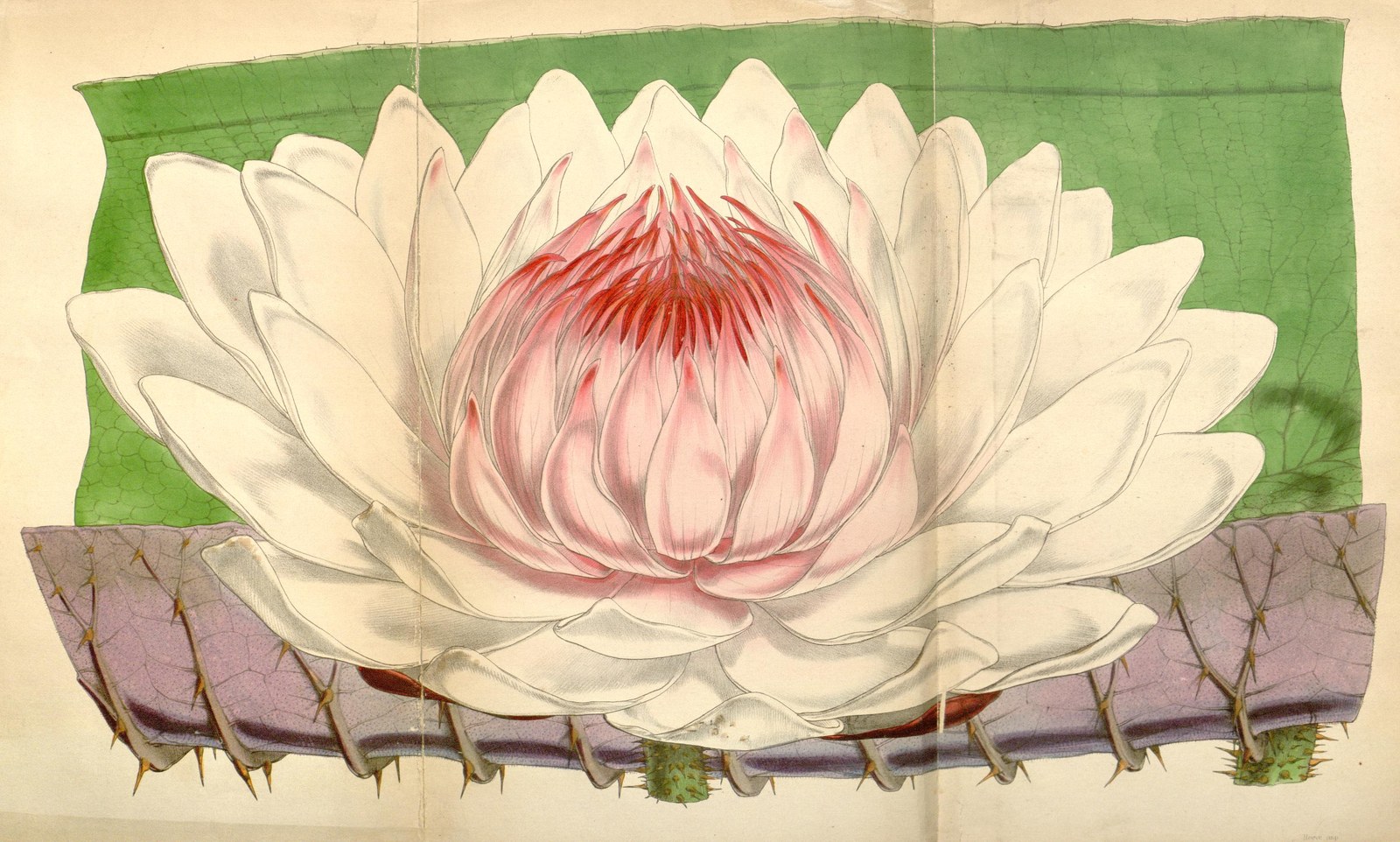
The giant waterlily of the Amazon, named for Queen Victoria, whose ribbed leaves inspired the Crystal Palace and whose flowers change sex overnight: the open flower, from Hooker's 1847 account.
- Published
- Plate 4276, volume 73, 1847
- From
- Curtis's Botanical Magazine
- Drawn by
- Walter Hood Fitch
- Lithograph
- Walter Hood Fitch
- Technique
- Hand-coloured lithograph
- Family
- Nymphaeaceae
- Native to
- The Amazon basin
About the plant
In the still backwaters of the Amazon, the giant waterlily unrolls leaves three metres across, flat green trays with rims turned up like a pie dish and, beneath, a lattice of ribs and air chambers so strong that a small child can stand on one. The flower is as theatrical as the leaf. It opens on the first evening pure white and scented of pineapple, warms itself above the temperature of the air, and draws in scarab beetles, then closes on them. Through the next day the trapped beetles feed on starchy tissue inside while the flower turns pink and sheds its pollen; on the second evening it reopens, now male, and lets them fly off, dusted, to the next white flower.
Robert Schomburgk met the plant in British Guiana in 1837 and sent descriptions home, and John Lindley named it Victoria regia for the queen crowned that year. It took another decade to flower in Europe. Seeds sent to Kew in 1849 were raised and shared, and it was Joseph Paxton at Chatsworth who, in a heated tank he designed for the purpose, brought the first bud to flower in November 1849. He stood his seven-year-old daughter Annie on a leaf for the press, and the ribbed structure of that leaf gave him the idea for the roof of the Crystal Palace two years later.
Kew built its Waterlily House in 1852 to grow it, and does still. This plate of the open flower, one of four in Hooker's 1847 account, was made before any plant had flowered in Britain, from drawings and specimens sent from South America.
Bought together
More in the archive