Pierre-Joseph Redouté del. · Lemaire sculp. · Didot jeune, Paris
Week of 2 June 2025
Garden tulip
Part 3 of 6 in Redouté's lilies
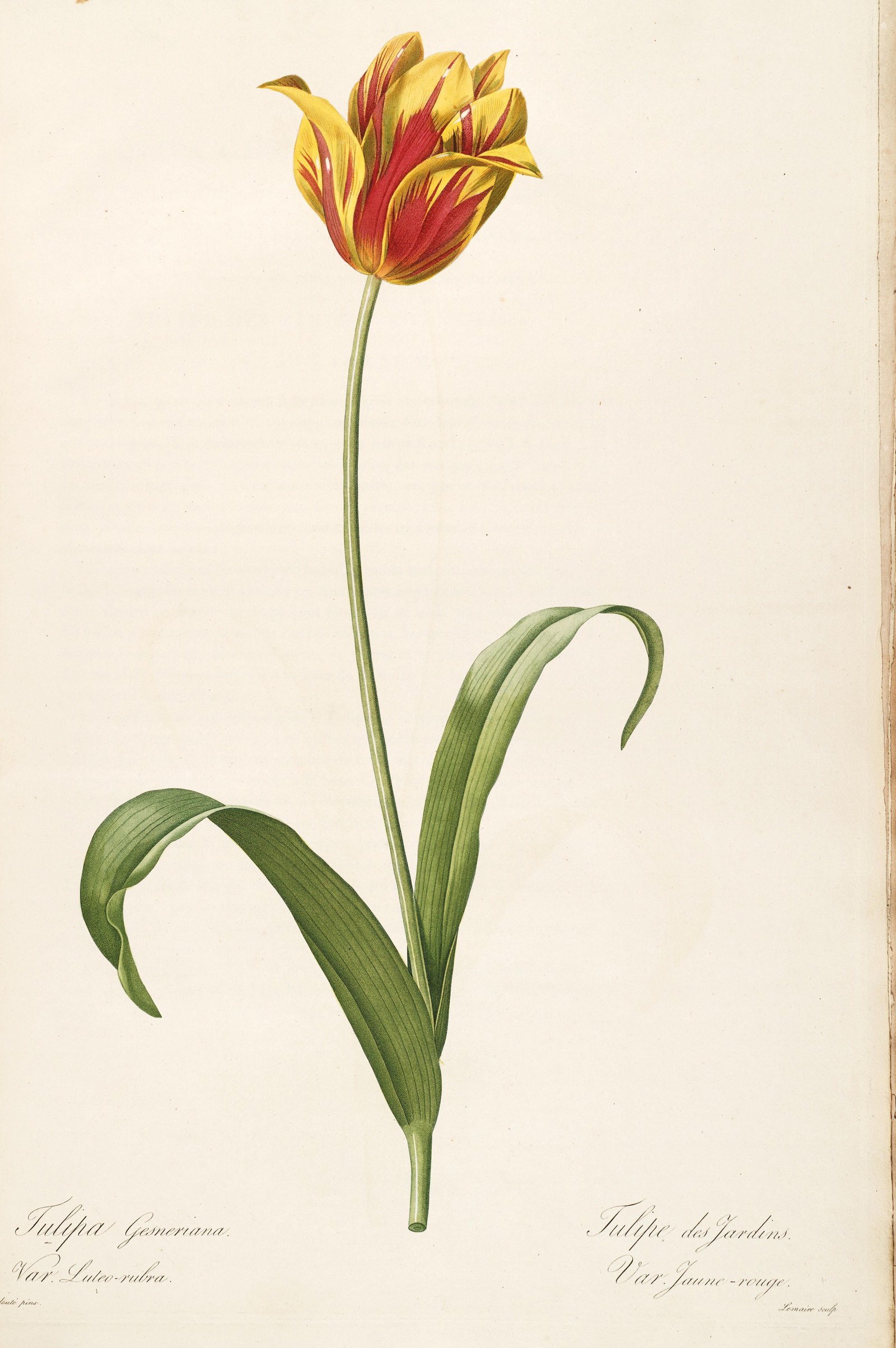
Tulipa gesneriana (published as Tulipa gesneriana var. luteo-rubra; Tulipe des jardins)
A red and yellow garden tulip, the flower of the Ottoman court and the Dutch mania, painted by Redouté for the last volume of Les Liliacées in 1816.
- Published
- volume 8, 1816
- From
- Les Liliacées
- Drawn by
- Pierre-Joseph Redouté
- Engraved by
- Lemaire
- Technique
- Colour-printed stipple engraving, finished by hand
- Family
- Liliaceae
- Native to
- Garden tulips, bred in Turkey and Holland from the wild tulips of Central Asia and the Caucasus
About the plant
The tulip is the flower that two civilisations went mad for. The Turks took the wild tulips of the Asian mountains into their gardens and bred them into the slender, pointed flowers of the Ottoman court, where the reign of Ahmed III in the 1720s is still called the Tulip Era; Europeans saw their first tulip at Augsburg in 1559, Conrad Gessner published it, and within eighty years the Dutch had bred the round garden tulip and driven its price to the sky in the mania of 1636–37, when a single rare bulb could buy a house. Linnaeus named the garden tulip for Gessner in 1753.
Redouté painted this red and yellow form for the eighth and last volume of Les Liliacées, which appeared in 1816, fourteen years after the first; the work had outlived its patron, for Josephine had died in 1814. The plate shows a single flamed flower on its stem with the grey leaves, engraved in stipple by Lemaire and printed in colour. The flamed red-and-yellow colouring was stable, unlike the feathering of the Dutch florists' tulips, which came from a virus and was the real object of the mania, and it is the pattern of the tulips still grown by the million in the fields of Holland.
Bought together
More in the archive