Pierre-Joseph Redouté del. · Didot jeune, Paris
Week of 26 May 2025
Crown imperial
Part 2 of 6 in Redouté's lilies
Fritillaria imperialis
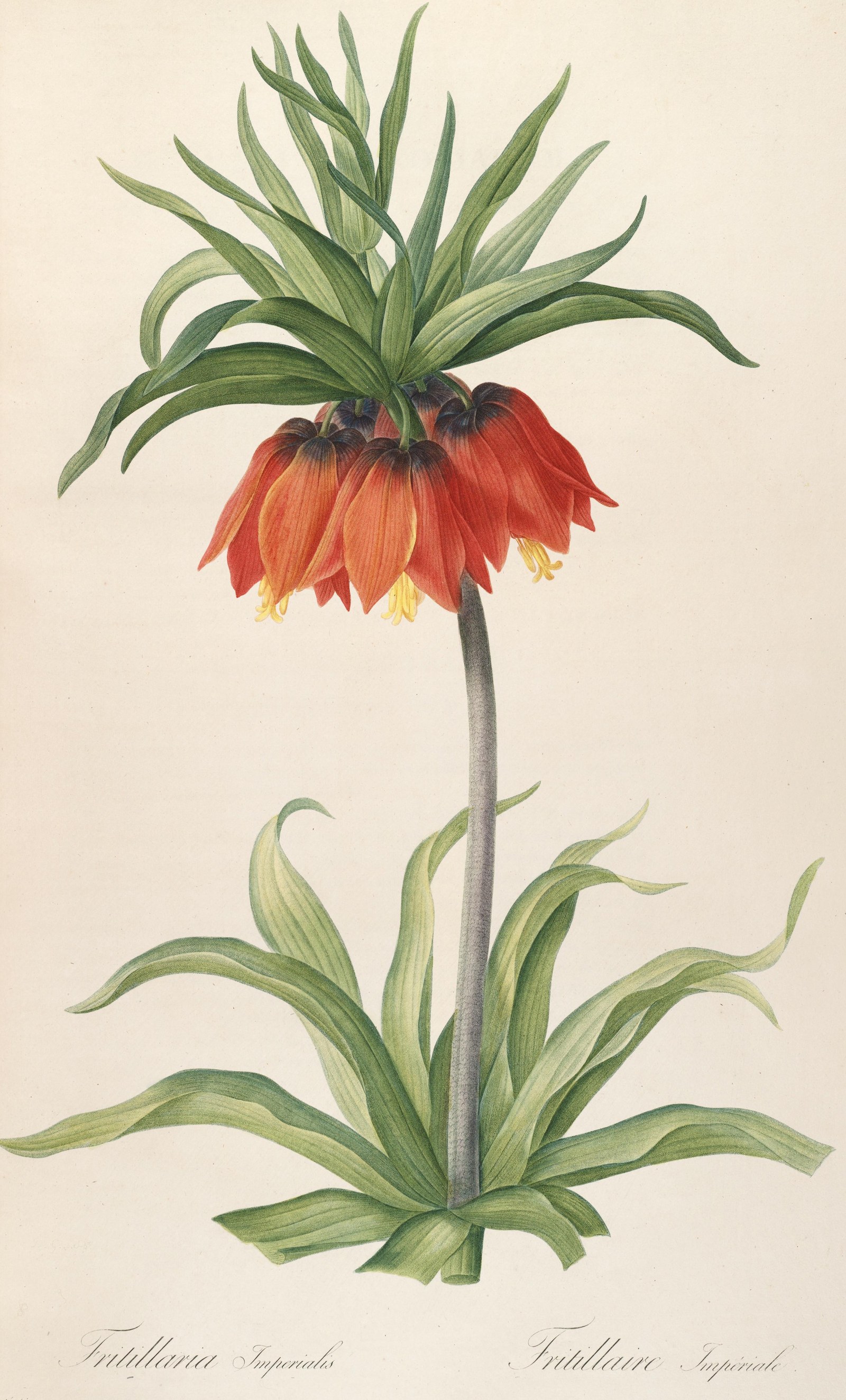
The crown imperial, a metre of stem topped by a ring of orange bells under a tuft of leaves, brought from Constantinople in the 1570s and painted by Redouté for Les Liliacées.
- Published
- volume 3, 1806
- From
- Les Liliacées
- Drawn by
- Pierre-Joseph Redouté
- Technique
- Colour-printed stipple engraving, finished by hand
- Family
- Liliaceae
- Native to
- Turkey, Iran, Afghanistan and the western Himalaya
About the plant
The crown imperial came west with the tulip. Carolus Clusius, keeper of the imperial gardens in Vienna, received it from Constantinople in the 1570s, and within a generation it stood in the parterres of every great garden in Europe, the tallest and strangest spring bulb anyone had seen: a thick stem a metre high, bare for most of its length, then a ring of hanging bells of orange or yellow and above them a tuft of green leaves like a pineapple top. It is a plant of the dry mountains of Turkey, Iran and Afghanistan to Kashmir, and it wants a hot, dry summer rest.
Look up into the bells and each holds a clear drop of nectar at the base of every petal, so heavy with sugar that it hangs and does not fall: the tears of the crown imperial, which according to the old story has wept since it alone of the flowers refused to bow its head in the garden of Gethsemane. The other thing everyone notices is the smell. Bulb, stem and leaves reek of fox, and gardeners plant it among their tulips in the belief that mice will not go near it. Redouté painted it in full splendour for the third volume of Les Liliacées.
Bought together
More in the archive