Pierre-Joseph Redouté del. · Firmin Didot, Paris
Week of 17 June 2024
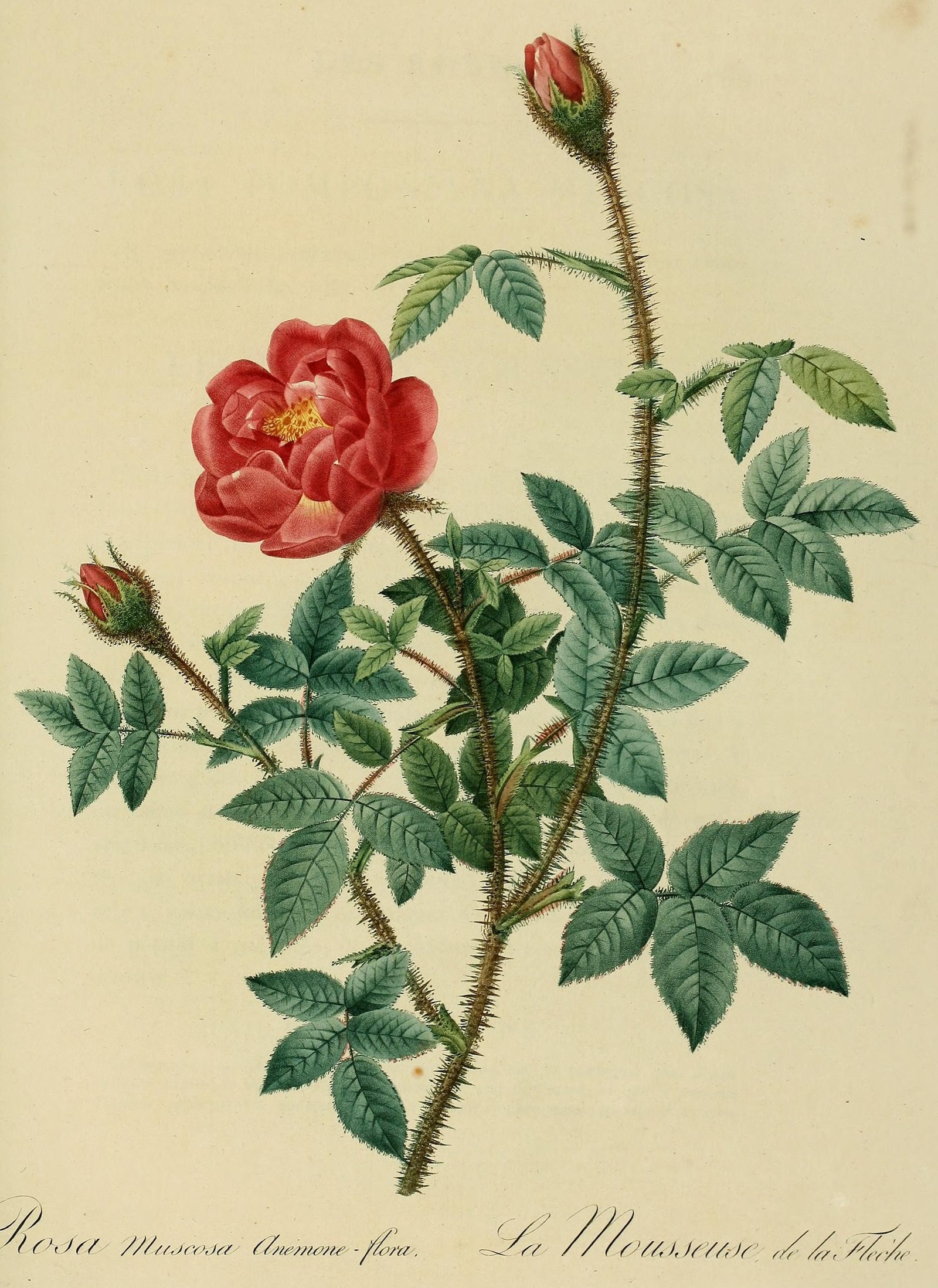
Anemone-flowered moss rose
Part 5 of 6 in Redouté's roses
Rosa × centifolia 'Muscosa Anemone-flora' (published as La Mousseuse de la Flèche)
A moss rose with the open, anemone-like flower that showed off its mossy buds, raised at La Flèche in Anjou and painted by Redouté for the last volume of Les Roses.
- Published
- volume 3, 1824
- From
- Les Roses
- Drawn by
- Pierre-Joseph Redouté
- Technique
- Colour-printed stipple engraving, finished by hand
- Family
- Rosaceae
- Native to
- A garden rose, a sport of the cabbage rose
About the plant
Early in the eighteenth century a cabbage rose somewhere in Europe threw a branch whose buds, sepals and stalks were covered in a dense growth of soft green glands that looked like moss and smelled, when touched, of pine resin. The sport was propagated and became the moss rose, and by 1800 no garden was without it; the Victorians, who loved anything quaint, loved it most of all. The moss is the whole point, and this form was raised to show it off: the flower is nearly single, a ring of crimson petals around a tuft of golden stamens like an anemone, so that the mossy calyx is in full view instead of being buried under a hundred petals.
It was raised at La Flèche in Anjou, and Thory, who wrote the text of Les Roses, called it la Mousseuse de la Flèche. Redouté painted it with a bud and an open flower on a mossy stem, and the plate came out in 1824 in the third and last volume, by which time Les Roses had taken seven years to publish and had made Redouté the most famous flower painter in Europe.
Bought together
More in the archive