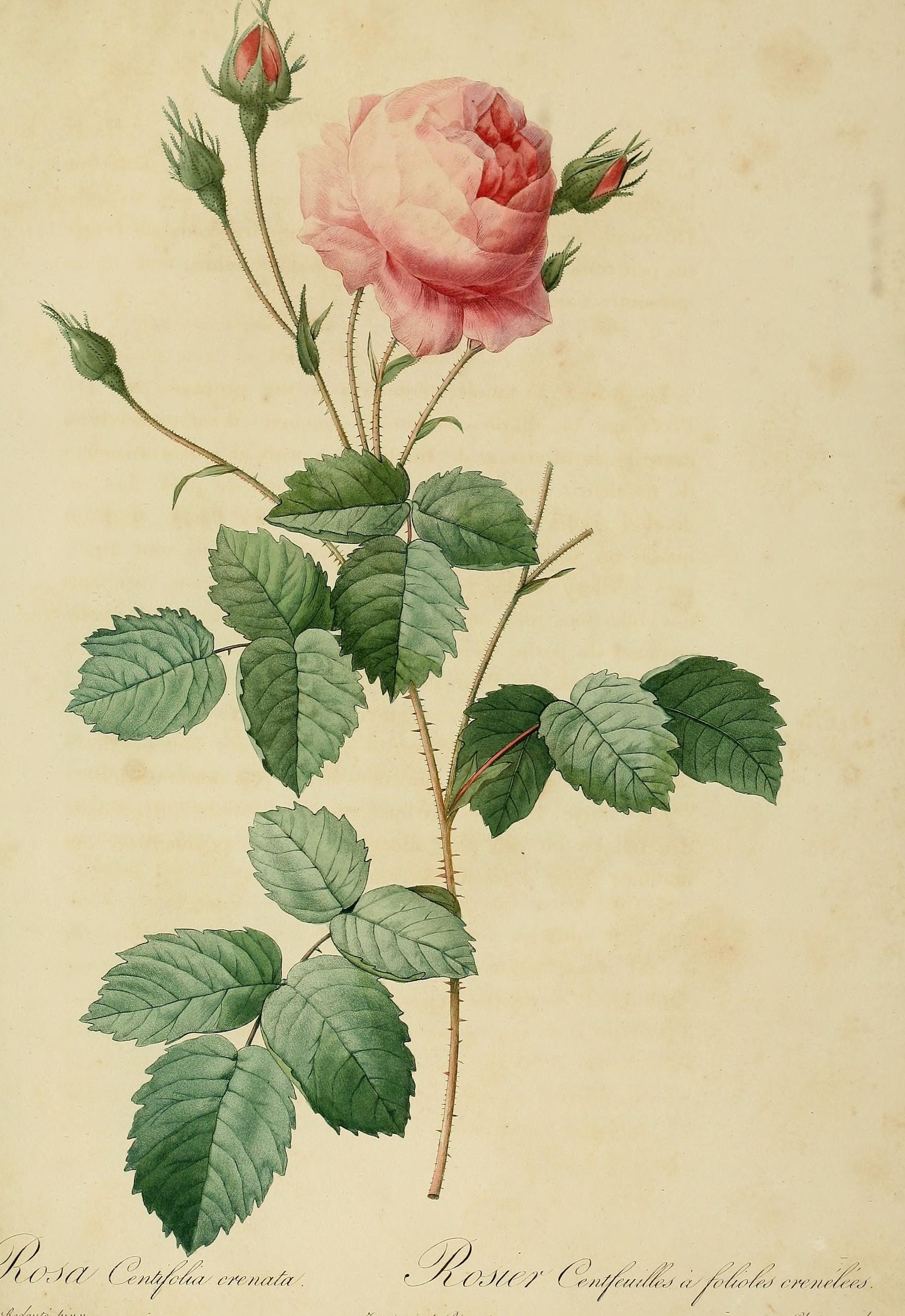
Pierre-Joseph Redouté del. · Chapuy sculp. · Firmin Didot, Paris
Week of 27 May 2024
Cabbage rose, crenate-leaved
Part 2 of 6 in Redouté's roses
Rosa × centifolia 'Crenata' (published as Rosier Cent-feuilles à folioles crénelées)
The cabbage rose of the Dutch flower painters, a hundred petals packed into a globe, in a form with scalloped leaflets that Redouté painted for Les Roses.
- Published
- volume 2, 1821
- From
- Les Roses
- Drawn by
- Pierre-Joseph Redouté
- Engraved by
- Chapuy
- Technique
- Colour-printed stipple engraving, finished by hand
- Family
- Rosaceae
- Native to
- A garden rose raised in Holland in the sixteenth and seventeenth centuries
About the plant
The cabbage rose is not a wild species but a creation of the Dutch nurseries, put together between the late sixteenth century and the early eighteenth from the damask, the gallica and others until it carried so many petals that they packed into a globe like the leaves of a cabbage: hence Rosa centifolia, the hundred-leaved rose. It is the rose of the Dutch and Flemish flower painters, heavy-headed and nodding, in pink with a scent that is still the standard for what a rose should smell of. At Grasse the perfumers grow it in fields and distil the petals in May.
Redouté painted it many times for Les Roses. This plate shows the form with crenate leaflets, their edges cut into rounded teeth, which Thory thought worth a plate of its own; the flower is the ordinary cabbage rose. The composition, a single open flower with its buds on a spray of foliage against the white of the page, was the one Redouté used for nearly all of the 169 plates, and it is the reason the book has been cut up and framed for two hundred years.
Bought together
More in the archive
Week of 17 June 2024 · 1824
Anemone-flowered moss rose
Rosa × centifolia 'Muscosa Anemone-flora'
From £10
Buy