Pierre-Joseph Redouté del. · Victor sculp. · Firmin Didot, Paris
Week of 3 June 2024
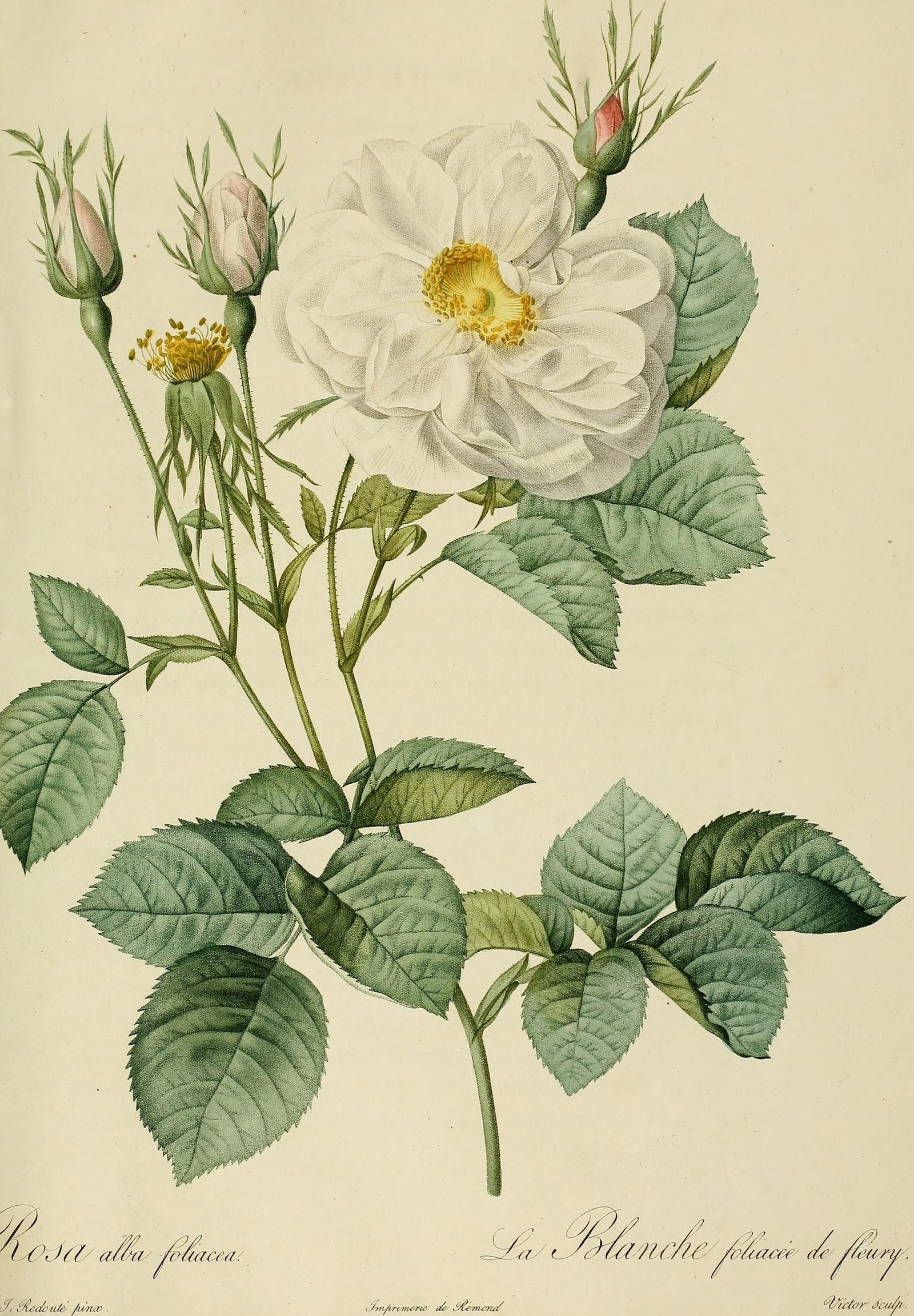
White rose of Fleury
Part 3 of 6 in Redouté's roses
Rosa × alba 'Foliacea' (published as La Blanche foliacée de Fleury)
The white rose, the oldest of the garden roses after the gallica, in a form whose buds are wrapped in leafy sepals, painted by Redouté for the last volume of Les Roses.
- Published
- volume 3, 1824
- From
- Les Roses
- Drawn by
- Pierre-Joseph Redouté
- Engraved by
- Victor
- Technique
- Colour-printed stipple engraving, finished by hand
- Family
- Rosaceae
- Native to
- A garden rose of ancient hybrid origin, grown in Europe since the Middle Ages
About the plant
The white rose is one of the two roses of the medieval garden, the other being the red gallica, and it is probably older than either of its names: a hybrid of the gallica with a wild dog rose, made nobody knows where or when, with grey-green leaves, a tall arching habit and flat white or blush flowers of a clean sweet scent. It was the white rose of York of the Wars of the Roses and the rose of the Dutch painters' bouquets beside the cabbage rose. The albas are among the toughest of all roses, flowering once in June, growing in half-shade and poor soil, and living for a century in a hedge.
Redouté painted this form for the third and last volume of Les Roses, published in 1824. What sets it apart is the sepals, enlarged into little leaves that wrap round the bud, hence foliacea, leafy; Thory called it the white rose of Fleury. The plate shows the open flower with its boss of yellow stamens, the buds in their leafy sheaths and the characteristic grey foliage. It was engraved in stipple by Victor and printed in colour by Rémond, the printer of the whole work.
Bought together
More in the archive
Week of 17 June 2024 · 1824
Anemone-flowered moss rose
Rosa × centifolia 'Muscosa Anemone-flora'
From £10
Buy