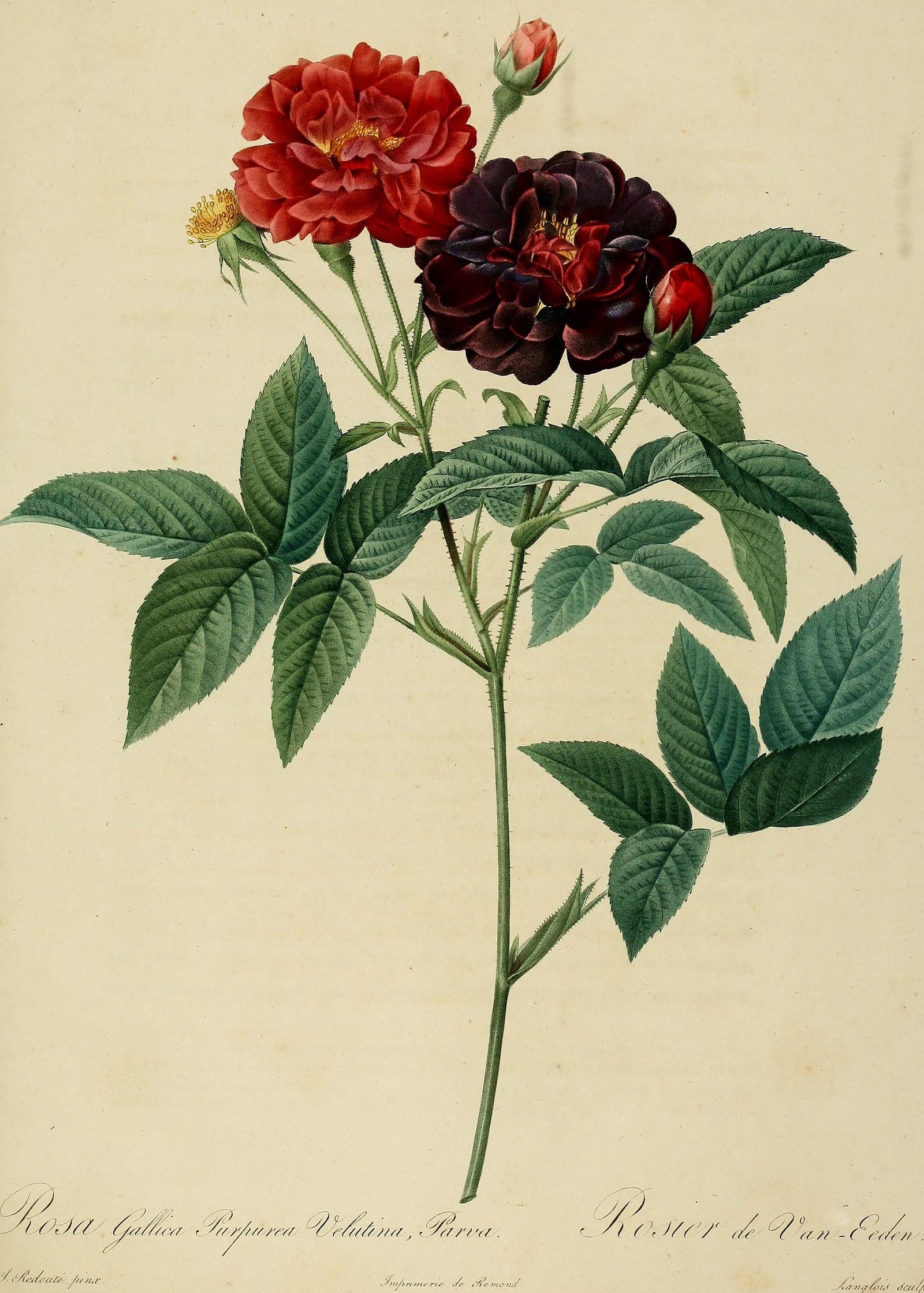
Pierre-Joseph Redouté del. · Langlois sculp. · Firmin Didot, Paris
Week of 20 May 2024
Velvet rose of Van Eeden
Part 1 of 6 in Redouté's roses
Rosa gallica 'Purpurea velutina parva' (published as Rosier de Van-Eeden)
A small deep-crimson gallica rose with petals like velvet, from the Van Eeden nursery at Haarlem, painted by Redouté for Les Roses and printed in colour from a stipple-engraved plate.
- Published
- volume 2, 1821
- From
- Les Roses
- Drawn by
- Pierre-Joseph Redouté
- Engraved by
- Langlois
- Technique
- Colour-printed stipple engraving, finished by hand
- Family
- Rosaceae
- Native to
- A garden form of Rosa gallica, the French rose, native from France to the Caucasus
About the plant
Pierre-Joseph Redouté, born in the Ardennes in 1759, painted flowers for Marie Antoinette, survived the Revolution, and became the painter of the Empress Josephine's garden at Malmaison, where she gathered every rose that could be had from Europe and beyond. Les Roses, published in Paris in thirty parts between 1817 and 1824, was the record of that garden and of the roses of the nurseries around Paris, with a text by the rose-grower Claude Antoine Thory. Josephine had died in 1814 before the first part appeared. The 169 plates were engraved in stipple, a technique of fine dots rather than lines, inked in colours on the single plate and printed in one pull, then touched up by hand, so that each impression has the softness of a watercolour.
The rose here is a gallica, the French rose, the oldest cultivated rose of Europe and the ancestor of most of the old garden roses: a low suckering shrub with flowers of a crimson that deepens almost to purple, the petals with the nap of velvet. This small form came from the nursery of the Van Eeden family at Haarlem, and Thory named it for them. The gallicas are the roses of the medieval garden; the apothecary's rose was grown in fields at Provins from the thirteenth century for rose water and the conserve of roses that every pharmacy sold.
Bought together
More in the archive
Week of 17 June 2024 · 1824
Anemone-flowered moss rose
Rosa × centifolia 'Muscosa Anemone-flora'
From £10
Buy