M. Hart del. · James Ridgway, London
Week of 21 April 2025
Lady Banks's rose
Part 3 of 6 in Georgian and Regency gardens
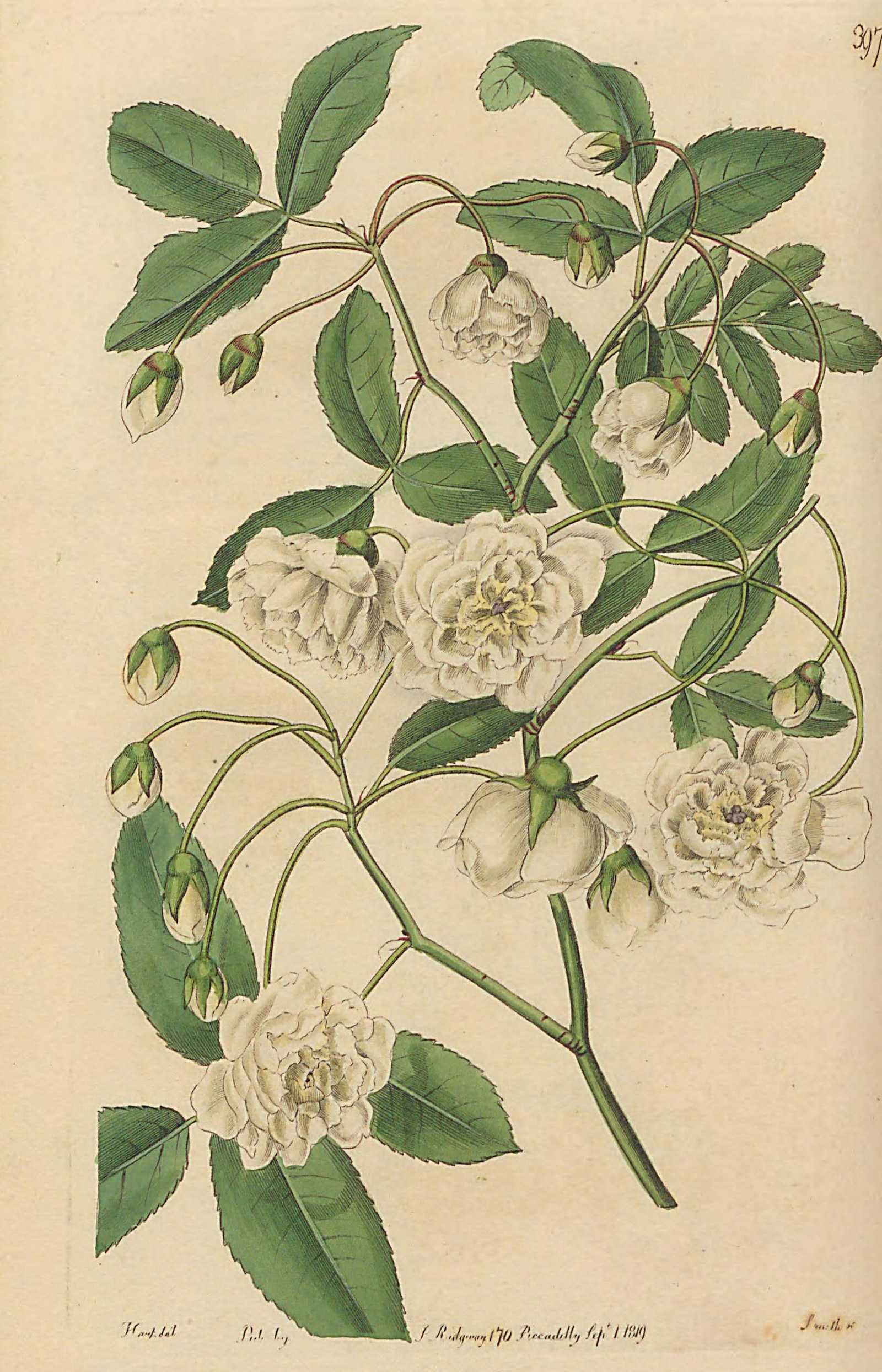
Rosa banksiae (published as Rosa banksiae flore pleno)
The thornless Chinese climber named for Lady Banks, its sprays of small double white roses smelling of violets, drawn for the Botanical Register twelve years after it reached Kew from Canton.
- Published
- Plate 397, volume 5, 1819
- From
- The Botanical Register
- Drawn by
- M. Hart
- Technique
- Hand-coloured copper engraving
- Family
- Rosaceae
- Native to
- Central and western China
About the plant
Sydenham Edwards had drawn the plates of Curtis's Botanical Magazine for nearly thirty years when, in 1815, he quarrelled with its publisher and set up a rival, the Botanical Register, with better paper, bigger plates and the same market: the owners of greenhouses who wanted to know what was new. He died in 1819, but the Register ran until 1847 under John Lindley and recorded, between them, most of the plants that came into England in the Regency and the early years of Victoria. This plate from 1819 shows a rose that had arrived at Kew twelve years before.
William Kerr, the gardener Sir Joseph Banks sent to Canton in 1803 to collect for Kew, shipped it home in 1807 from a Chinese garden, and Banks named it for his wife Dorothea. It is unlike any European rose: evergreen, without thorns, climbing to ten metres or more, and flowering in April in sprays of small double rosettes, white in this form and smelling of violets. The yellow form, which came in 1824, is the one most gardens grow now, and both are as vigorous as anything in the rose family. A single plant of the white rose set in 1885 outside a boarding house in Tombstone, Arizona, now shades a courtyard of more than eight hundred square metres and is the largest rose bush in the world.
Bought together
More in the archive