M. Hart del. · S. Watts sculp. · James Ridgway, London
Week of 12 May 2025
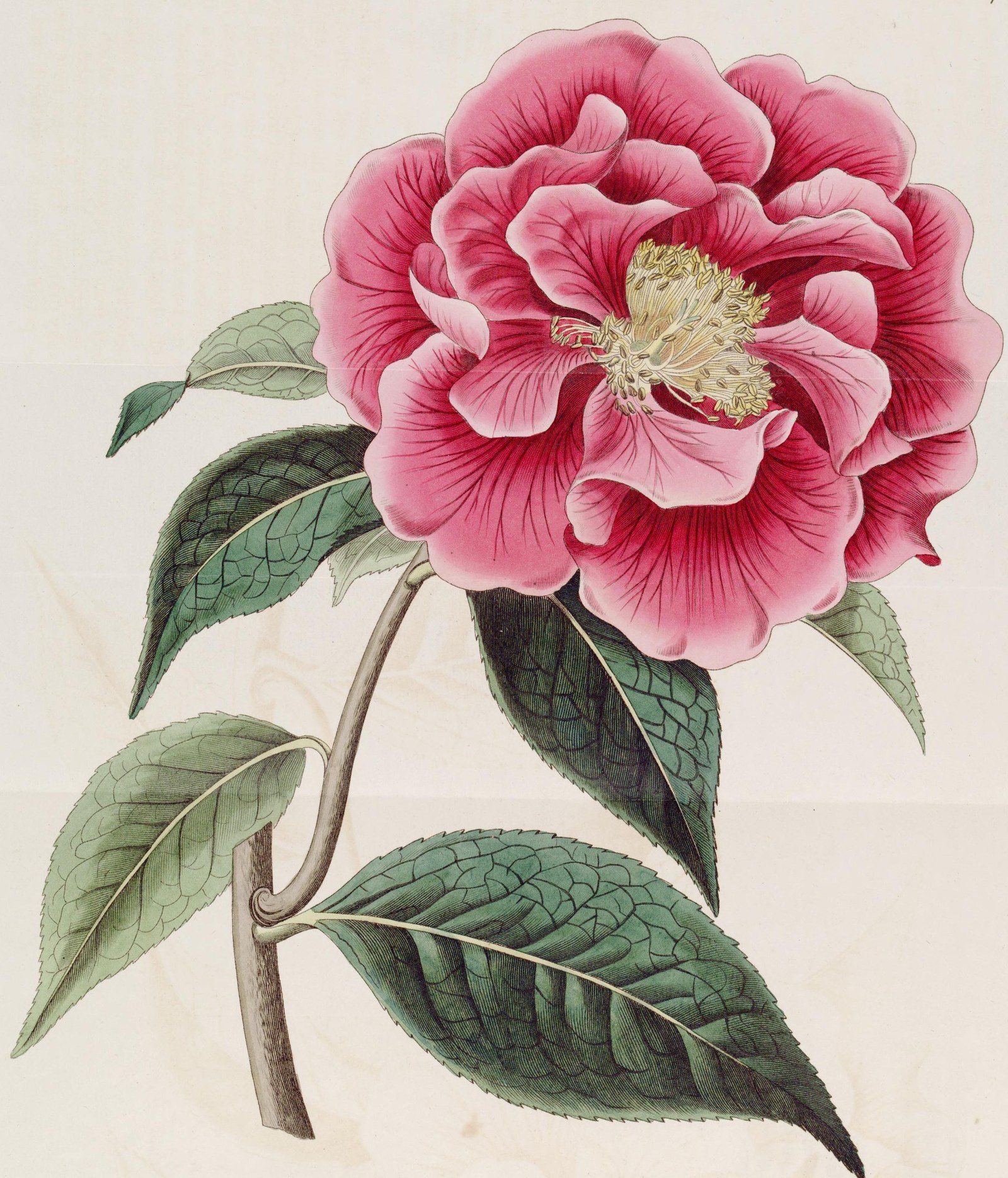
Captain Rawes's camellia
Part 6 of 6 in Georgian and Regency gardens
Camellia reticulata
The great camellia of Yunnan in the form Captain Rawes brought from Canton in 1820, with the largest flowers in the genus, drawn at Bromley for the Botanical Register from the first plant to flower in England.
- Published
- Plate 1078, volume 13, 1827
- From
- The Botanical Register
- Drawn by
- M. Hart
- Engraved by
- S. Watts
- Technique
- Hand-coloured copper engraving
- Family
- Theaceae
- Native to
- Yunnan, south-west China
About the plant
For a century after the first camellias reached Europe, all of them were forms of Camellia japonica, neat and formal. Then in 1820 Captain Richard Rawes, who commanded an East Indiaman on the China run, brought home from a Canton nursery a plant that flowered six years later in the conservatory of his friend Thomas Carey Palmer at Bromley in Kent, and it was something else entirely: flowers as big as a hand, loose, waved and crinkled, in a rose-pink veined with deeper colour. John Lindley described it as a new species in the Botanical Register in 1827 and named it reticulata for the netted veining of its leaves.
What Rawes had brought was a garden form of the tree camellia of Yunnan, grown for centuries in the temple courtyards of Kunming, where trees several hundred years old flower every spring. The wild plant, with single flowers, was not seen by a European botanist until George Forrest found it in 1924. 'Captain Rawes' is still in cultivation, nearly two hundred years on, and the Yunnan camellias bred from it in the twentieth century have the largest flowers of the genus. Lindley's plate was drawn from the Bromley plant in its first season.
Bought together
More in the archive