Henry George Moon del. · Joseph Mansell lith. · Frederick Sander, St Albans
Week of 31 March 2025
Crispum orchid
Part 9 of 9 in Orchid mania
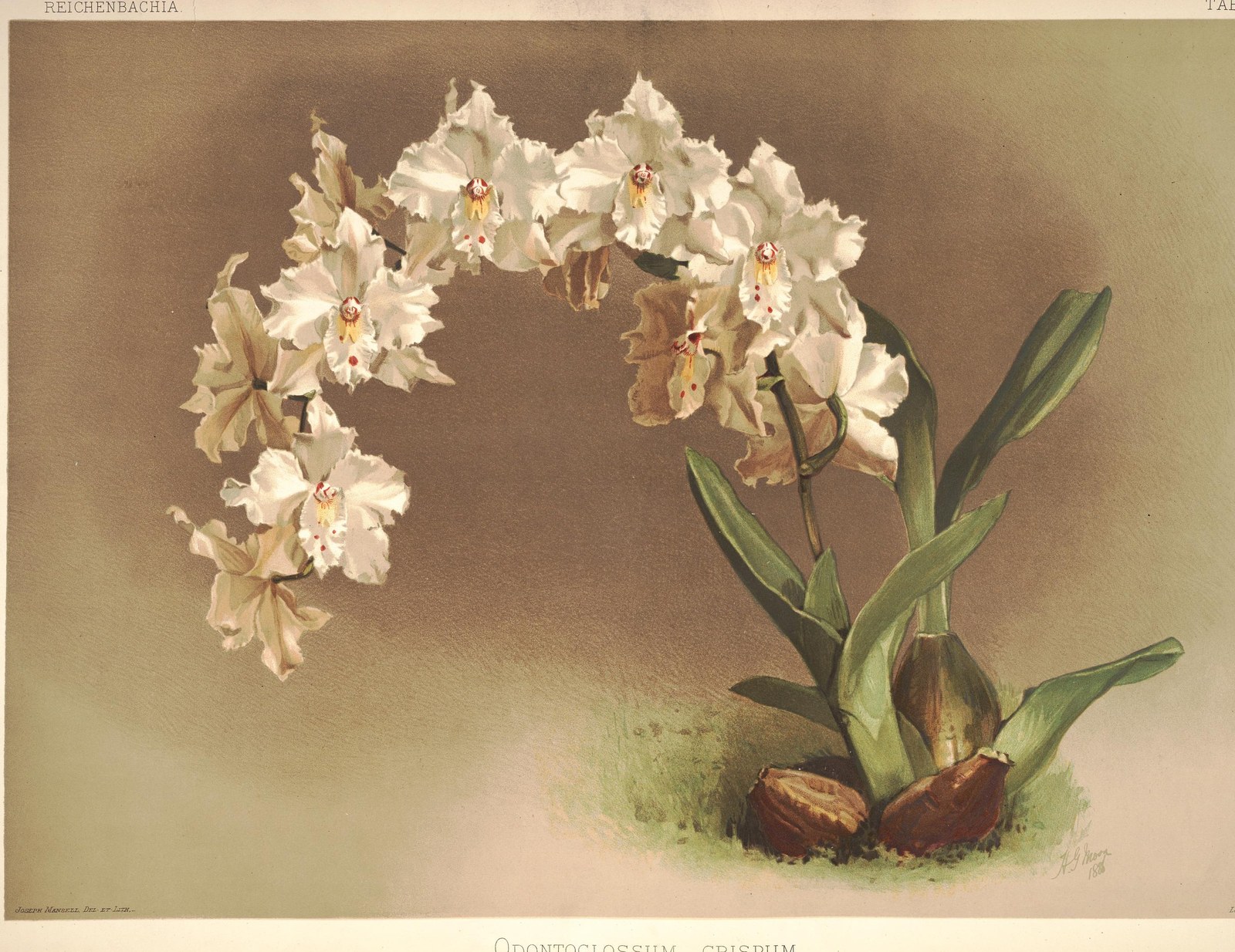
Odontoglossum crispum (published as Odontoglossum alexandrae)
The white crispum orchid of the Colombian cloud forest, the most coveted orchid of the Victorian age, painted by Henry Moon for the first plate of Sander's Reichenbachia.
- Published
- Plate 1, volume 1, 1888
- From
- Reichenbachia
- Drawn by
- Henry George Moon
- Lithograph
- Joseph Mansell
- Technique
- Chromolithograph
- Family
- Orchidaceae
- Native to
- The cloud forests of the Colombian Andes, at 2,000 to 3,000 metres
About the plant
Frederick Sander came from Bremen to England as a young man, married into a seed business and built at St Albans the largest orchid nursery in the world, with sixty glasshouses, twenty collectors in the field at a time and a clientele of dukes and millionaires. Reichenbachia was his monument: four imperial-folio volumes published between 1888 and 1894, named for his friend the Hamburg orchidologist Heinrich Gustav Reichenbach, with plates painted by Henry Moon, a landscape painter who had never drawn an orchid before Sander hired him and who married Sander's daughter. The plates were printed by chromolithography from Moon's paintings, and nothing of their kind has been done better.
The plant Sander put first was the one his fortune was built on. Odontoglossum crispum grows on the trunks of oaks in the cloud forest of the Colombian Andes, where it is cool and wet all year, and its arching sprays of white flowers with crisped petal edges, flushed and spotted in a thousand variations, made it the one orchid every collection had to have. The best forms sold for hundreds of guineas. Sander's collectors sent it home by the hundred thousand, felling the forest to reach the plants, and most died on the way; by 1900 whole valleys had been stripped. The plant survives, and the hybrids bred from it are the odontoglossums of today.
Bought together
More in the archive