Peter Henderson del. · Dr Robert Thornton, London
Week of 28 July 2025
Sacred lotus
Part 5 of 6 in The Temple of Flora
Nelumbo nucifera (published as Nelumbium speciosum)
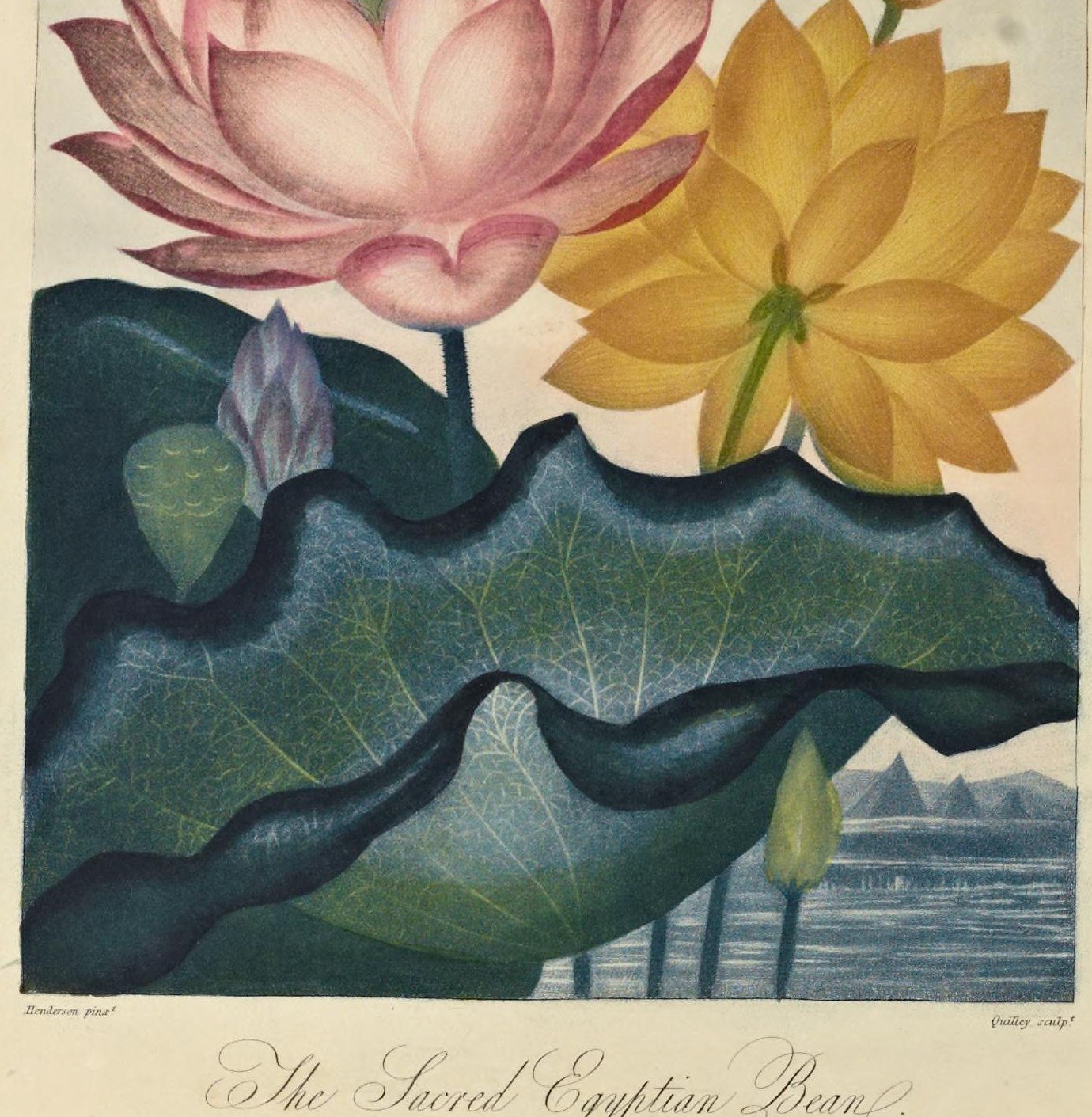
The sacred lotus of India and Egypt, painted by Peter Henderson for Thornton's Temple of Flora as 'The Sacred Egyptian Bean', with a pyramid in the distance and a leaf cupping water like silver.
- Published
- 1804
- From
- The Temple of Flora
- Drawn by
- Peter Henderson
- Technique
- Colour-printed aquatint and mezzotint, finished by hand
- Family
- Nelumbonaceae
- Native to
- Asia, from Iran to Japan and Australia
About the plant
Thornton's painters set each plant in a landscape that explained it, and for the lotus Peter Henderson painted a pyramid on the horizon, because the ancient writers had described the plant in the Nile. Herodotus called it the Egyptian bean and said the Egyptians ate its seeds and its root, and so they did, though the lotus is an Asian plant that the Persians or Greeks had carried west. In India and China it is the most sacred of flowers, the seat of Lakshmi and the Buddha, rising unstained from the mud.
It is not a waterlily, whatever it looks like: its nearest relatives are the plane trees, and its leaves stand clear of the water on stalks a metre tall, so perfectly water-repellent that a drop rolls across them like mercury, a trick engineers now copy. The flowers, pink or white and as wide as a dinner plate, heat themselves on cold nights to keep their beetle pollinators comfortable, and the seeds in the shower-head receptacle can wait centuries: lotus seeds more than a thousand years old, dug from a dry lake bed in Manchuria, have sprouted. The plate was published in 1804, finished by hand over a colour-printed engraving.
Bought together
More in the archive