Philip Reinagle and Abraham Pether del. · Robert Dunkarton sculp. · Dr Robert Thornton, London
Week of 14 July 2025
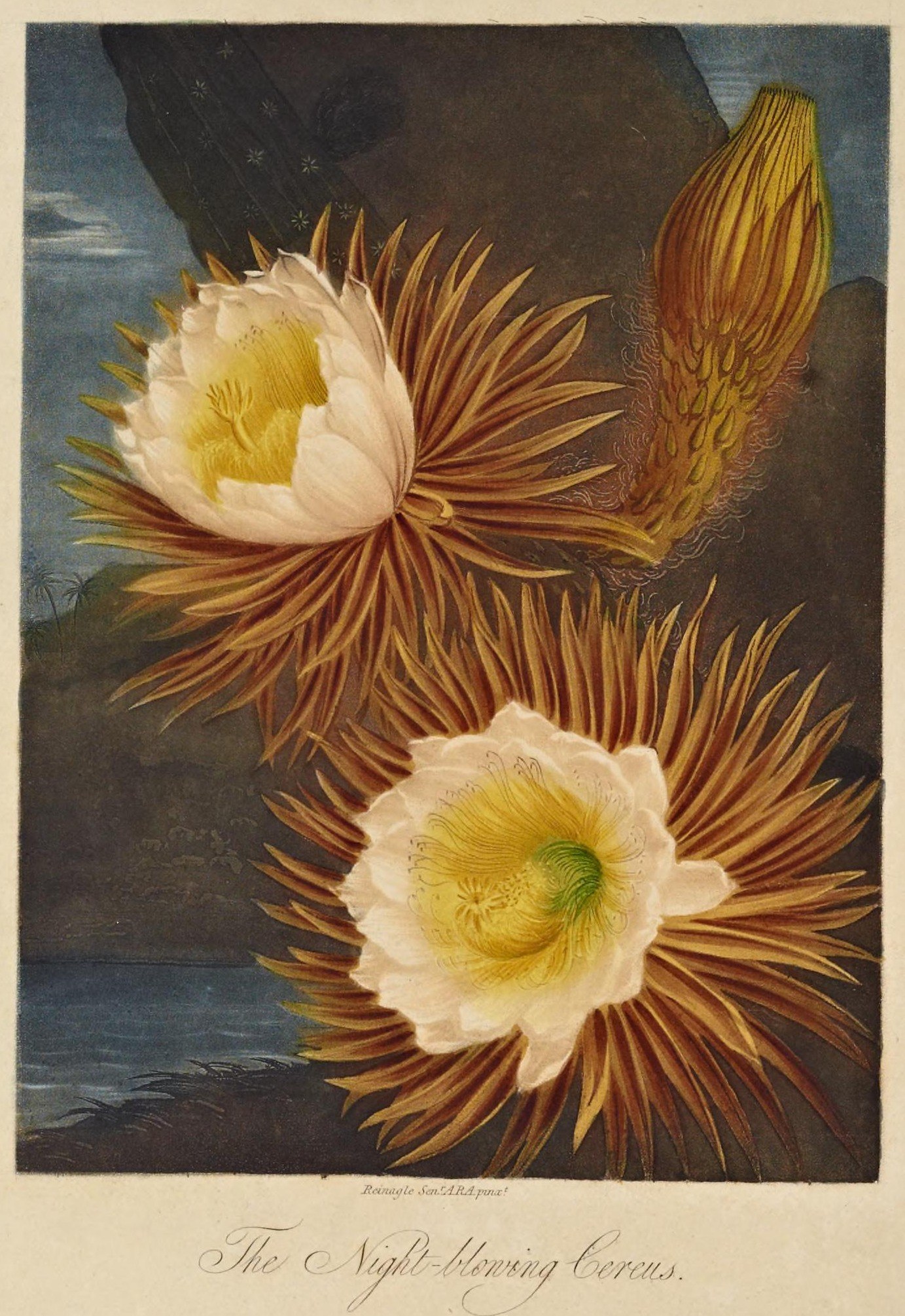
Night-blowing cereus
Part 3 of 6 in The Temple of Flora
Selenicereus grandiflorus (published as Cactus grandiflorus)
The most famous plate in the most extravagant flower book ever printed: a cactus that opens one enormous scented flower at midnight, painted against a moonlit church tower whose clock stands at twelve.
- Published
- 1800
- From
- The Temple of Flora
- Drawn by
- Philip Reinagle and Abraham Pether
- Engraved by
- Robert Dunkarton
- Technique
- Colour-printed aquatint and mezzotint, finished by hand
- Family
- Cactaceae
- Native to
- The Caribbean, Mexico and Central America
About the plant
Robert Thornton, a London physician with money and a mission, set out in 1797 to produce the grandest flower book ever made: a 'Temple of Flora' in which the best painters in England would show each plant in a landscape expressing its character, engraved by the best engravers, printed in colour. It took ten years, ran through his fortune, and was finished off by a lottery that Parliament licensed to save him. The plate everyone remembers is this one. Philip Reinagle painted the flower of the night-blowing cereus, and Abraham Pether, who specialised in moonlight, painted the river, the church and the clock, which stands at midnight, the hour the flower opens.
The plant is a real one: a climbing cactus of the Caribbean and Mexico with thin, ribbed, snaking stems that clamber over trees and walls by aerial roots. For most of the year it is nothing to look at. Then a bud swells, and after dark it unfurls into a flower nearly a foot across, white within, gold without, scented of vanilla so strongly that it fills a greenhouse, and by sunrise it has collapsed. Bats and hawkmoths pollinate it in the wild; in English stove houses, where it had been grown since the 1700s, gardeners sat up with lanterns to watch.
Bought together
More in the archive