Peter Henderson del. · Dr Robert Thornton, London
Week of 7 July 2025
Dragon arum
Part 2 of 6 in The Temple of Flora
Dracunculus vulgaris (published as Arum dracunculus)
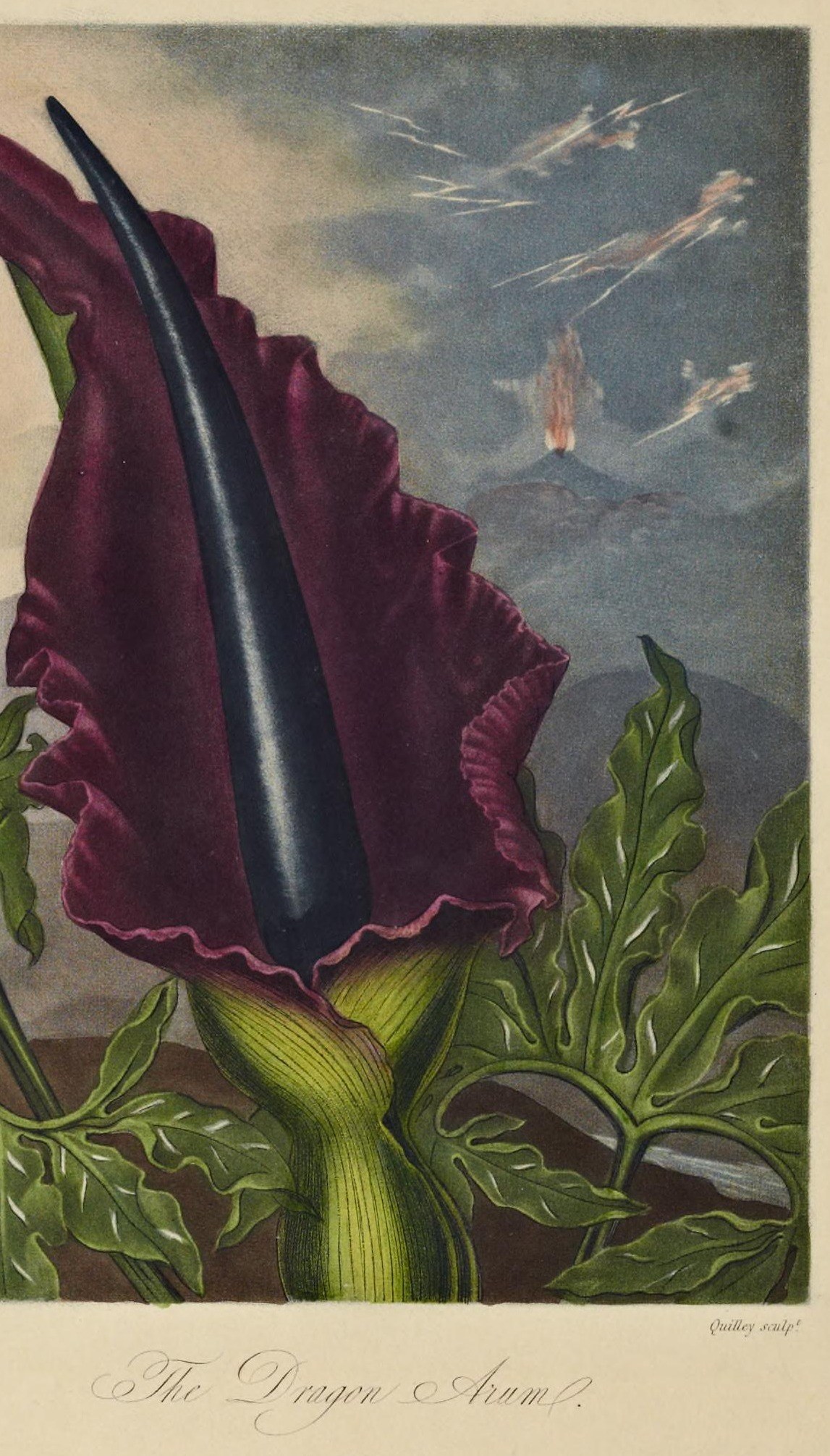
The dragon arum of Greece, a maroon spathe a metre tall smelling of carrion, painted for the Temple of Flora against a thunderstorm to match its temper.
- Published
- 1801
- From
- The Temple of Flora
- Drawn by
- Peter Henderson
- Technique
- Colour-printed aquatint and mezzotint, finished by hand
- Family
- Araceae
- Native to
- Greece, the Balkans and the Aegean islands
About the plant
Of all the plants in Thornton's book the dragon arum was the one that most suited his taste for drama. It is a Greek plant, growing in olive groves and on stony hillsides from the Peloponnese to Crete, and in May it throws up a snake-mottled stem and a hooded spathe up to a metre tall, blood-purple within, around a spadix as black as a burnt candle. For a day it smells of a dead sheep, and blowflies come from across the valley, crawl down into the chamber at its base, and pollinate the hidden flowers before the spathe withers and lets them go.
Peter Henderson painted it against a thunderous sky with a cliff and a distant shore, and the plate appeared in 1801. The ancients thought a plant that looked so like a serpent must protect against them, and Dioscorides prescribed it accordingly; gardeners who grow it today do so for the sake of one spectacular week a year, and plant it well away from the house.
Bought together
More in the archive