Pierre-Joseph Redouté del. · Didot jeune, Paris
Week of 19 May 2025
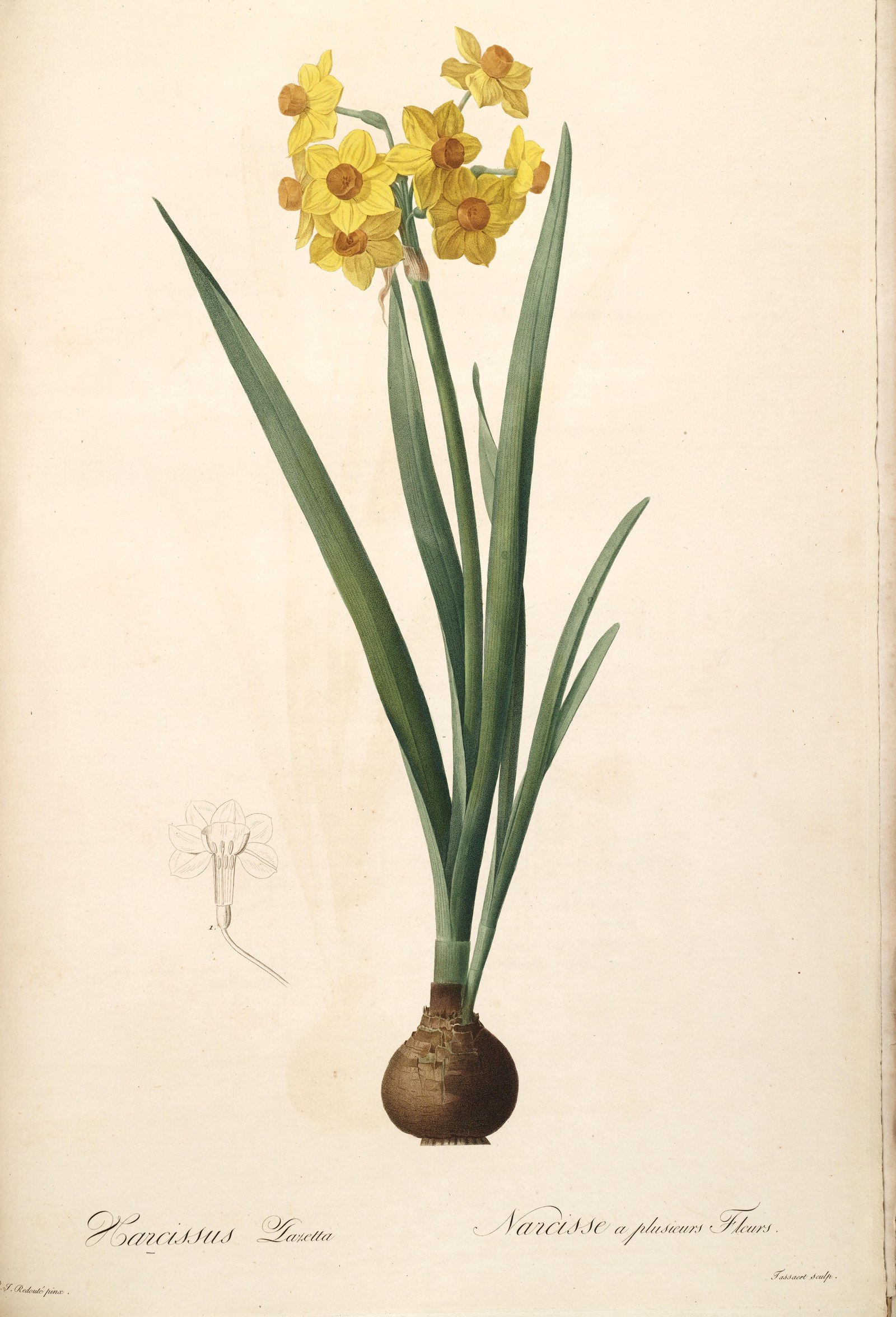
Bunch-flowered narcissus
Part 1 of 6 in Redouté's lilies
Narcissus tazetta
The bunch-flowered narcissus of the Mediterranean, the sacred lily of China and the paperwhite of the winter windowsill, painted by Redouté for the first volume of Les Liliacées.
- Published
- volume 1, 1802
- From
- Les Liliacées
- Drawn by
- Pierre-Joseph Redouté
- Technique
- Colour-printed stipple engraving, finished by hand
- Family
- Amaryllidaceae
- Native to
- The Mediterranean east to Iran; naturalised from the Scilly Isles to China and Japan
About the plant
The bunch-flowered narcissus is the daffodil of the south: not the single yellow trumpet of the English wood but a stem carrying half a dozen small flat flowers, white with a cup of deep yellow, and a scent that fills a room. It grows wild from Portugal to Iran and was carried east along the trade routes so early that the Chinese took it for their own: as the sacred lily of the New Year, forced in bowls of pebbles and water, it has been the flower of good fortune in China for a thousand years. In the west it became the paperwhite of the winter windowsill and the 'Soleil d'Or' of the flower shops.
Redouté painted it in the first volume of Les Liliacées in 1802, two flowering stems from the bulb with the dissected flower beside them, and de Candolle wrote its description. The narcissus was on the Isles of Scilly long before then, run wild in the fields, and in the 1870s a farmer on St Mary's sent a box of its flowers to Covent Garden on the steamer to see what they would fetch; from that box came the Scilly flower trade, which has sent narcissi to London every winter since.
Bought together
More in the archive