Pierre-Joseph Redouté del. · de Gouy sculp. · Didot jeune, Paris
Week of 9 June 2025
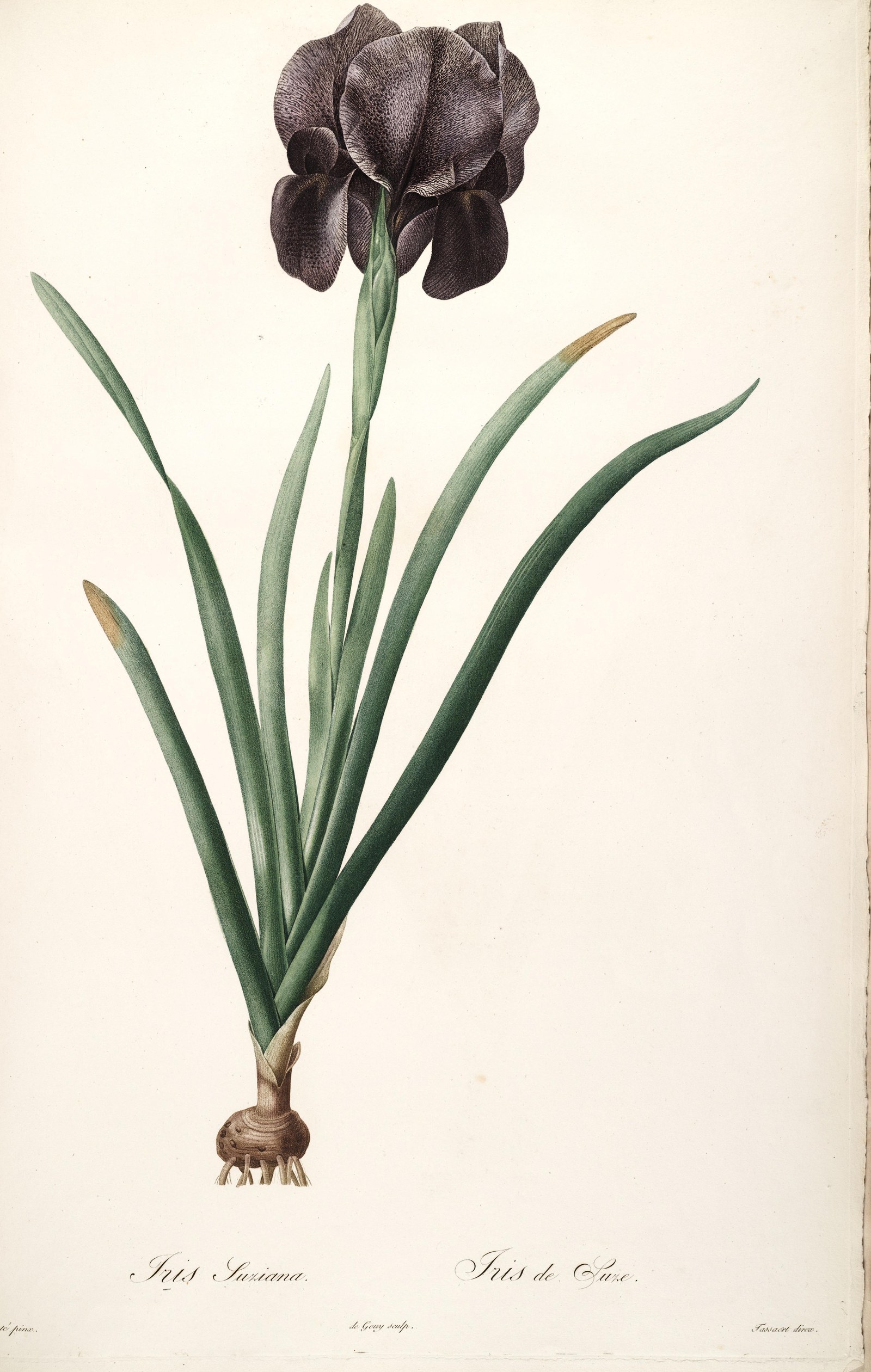
Mourning iris
Part 4 of 6 in Redouté's lilies
Iris susiana (published as Iris suziana)
The mourning iris, grey petals netted with black-purple and a black velvet patch on the falls, a Turkish garden flower of the sixteenth century painted by Redouté for the first volume of Les Liliacées.
- Published
- volume 1, 1802
- From
- Les Liliacées
- Drawn by
- Pierre-Joseph Redouté
- Engraved by
- de Gouy
- Technique
- Colour-printed stipple engraving, finished by hand
- Family
- Iridaceae
- Native to
- The Near East; grown in Europe since 1573 and known only from gardens
About the plant
Iris susiana was the sensation of the sixteenth-century garden, the flower that showed the Renaissance what the East could send: a single enormous bloom, the standards grey and netted all over with fine purple-black veins, the falls darker still and marked with a patch of black velvet and a black beard. Clusius grew it in Vienna in 1573 from rhizomes that had come from Constantinople, and the Turks told him it came from Susa in Persia, hence the name. Nobody has found it wild since; it is probably an old selection of one of the oncocyclus irises of Turkey or Lebanon, kept alive for four hundred years by division.
Redouté painted it for the first volume of Les Liliacées in 1802, the stiff grey fans of leaves and the one great sombre flower that gave it the English name of mourning iris. It is not an easy plant. Like all the oncocyclus irises it comes from country with a short wet spring and a long baked summer, and in a damp climate it rots unless it is lifted or kept under glass. The black patch on the falls is a signal to the solitary male bees that pollinate the group, which shelter in the flowers overnight.
Bought together
More in the archive