George Cooke del. · George Cooke sculp. · Conrad Loddiges & Sons, Hackney
Week of 5 May 2025
Yellow cucumber tree
Part 5 of 6 in Georgian and Regency gardens
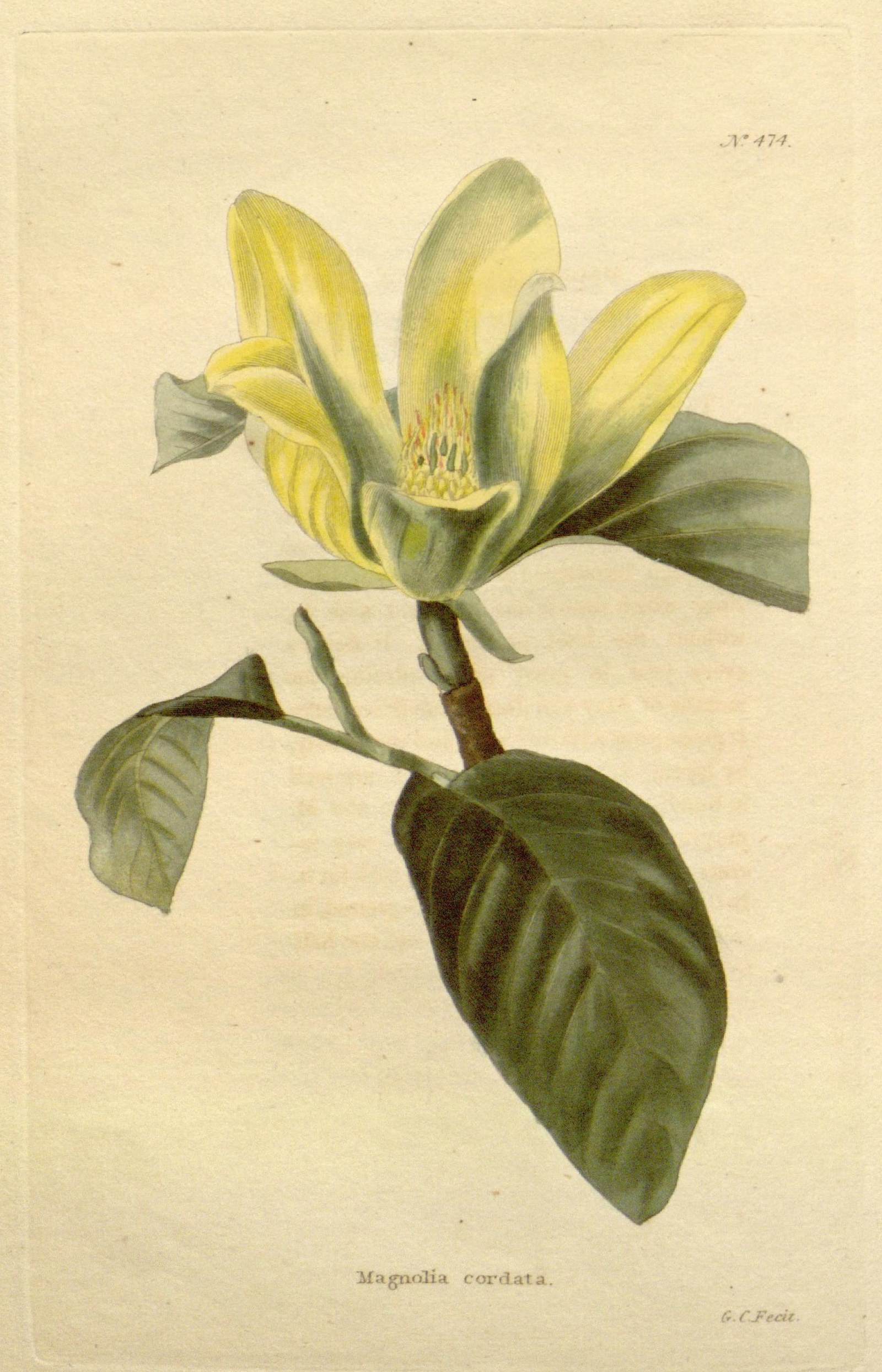
Magnolia acuminata var. subcordata (published as Magnolia cordata)
The yellow-flowered magnolia of Georgia, the only yellow magnolia the nineteenth century knew and the ancestor of all the yellow magnolias bred since, drawn from the Loddiges nursery's tree in 1820.
- Published
- Plate 474, volume 5, 1820
- From
- The Botanical Cabinet
- Drawn by
- George Cooke
- Engraved by
- George Cooke
- Technique
- Hand-coloured copper engraving
- Family
- Magnoliaceae
- Native to
- Georgia and the Carolinas, south-eastern United States
About the plant
The cucumber tree is the big deciduous magnolia of the Appalachian forests, named for its green knobbly fruits, with flowers that are greenish and easy to miss. In the piedmont of Georgia, around Augusta, the French collector André Michaux found a smaller tree with flowers of clear pale yellow, sent it to the nurseries of France in the 1790s and named it Magnolia cordata in his Flora of North America in 1803. It was the only yellow magnolia anyone knew, and it remained so until breeders in the twentieth century crossed it with the Asiatic magnolias to produce the yellow garden magnolias of today, every one of which has this tree in its ancestry.
The Loddiges nursery at Hackney had it in flower by 1820, and George Cooke drew it for the Botanical Cabinet with the cupped yellow flower and the leaf behind. Botanists have never quite agreed what it is; the current view is that it is a southern variety of the cucumber tree, Magnolia acuminata var. subcordata, and in the wild it is rare. Magnolias are the oldest of the flowering trees, their flowers built to be pollinated by beetles before bees existed, which is why they are tough enough to be crawled over and chewed.
Bought together
More in the archive