Ferdinand Bauer del. · James Sowerby sculp. · Richard Taylor for the executors of John Sibthorp, London
Week of 16 September 2024
Persian cyclamen
Part 6 of 6 in The plants of Greece
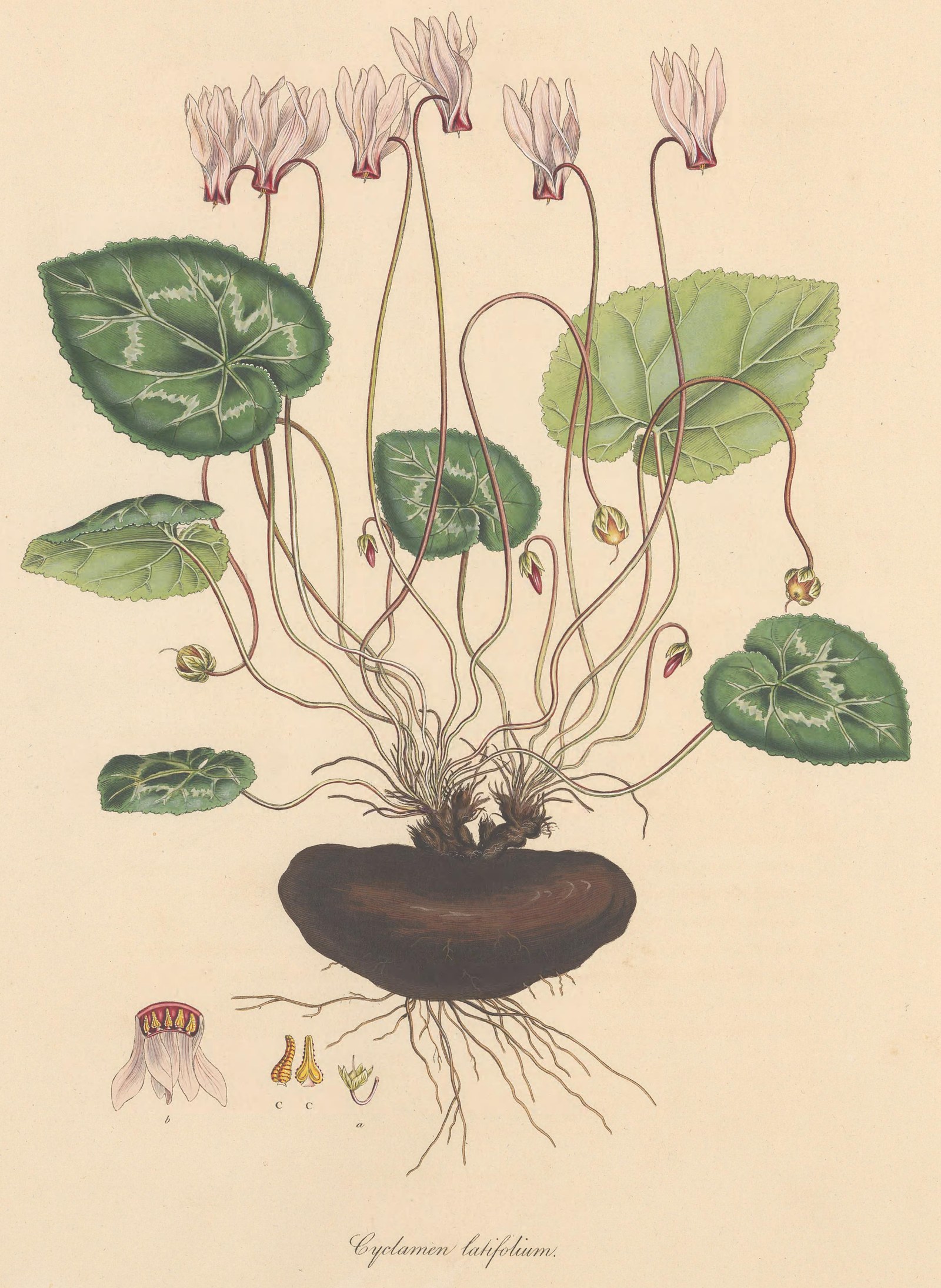
Cyclamen persicum (published as Cyclamen latifolium)
The wild ancestor of every florist's cyclamen, painted by Ferdinand Bauer from the plants of the Greek islands and published in Flora Graeca as Cyclamen latifolium.
- Published
- Plate 185, volume 2, 1813
- From
- Flora Graeca
- Drawn by
- Ferdinand Bauer
- Engraved by
- James Sowerby
- Technique
- Hand-coloured copper engraving
- Family
- Primulaceae
- Native to
- The eastern Mediterranean, from the Aegean islands and Crete to Cyprus, the Levant and Libya
About the plant
Bauer painted this cyclamen from the plants he and Sibthorp found in the Greek islands in the spring of 1787, flowering in the shade of rocks and old walls: a mass of swept-back flowers, white flushed with pink and stained magenta at the mouth, rising from a big flat corm. Smith, who wrote the text of Flora Graeca after Sibthorp's death, called it Cyclamen latifolium, the broad-leaved cyclamen. Philip Miller of the Chelsea Physic Garden had already named it Cyclamen persicum in 1768, on the belief that it came from Persia; it does not, but the earlier name stands.
This is the species that became the florist's cyclamen. From the 1860s growers in England, Germany and Holland selected the small scented wild flower into the big pot plants in every colour from white to crimson that fill the shops each winter, and in doing so lost most of the scent. The wild plant keeps it. Like all cyclamens it is a member of the primrose family, oddly enough, and like all of them it is a plant of the Mediterranean winter: it grows and flowers in the cool wet months and sleeps through the summer as a corm underground.
Bought together
More in the archive