Philip Reinagle del. · Richard Earlom sculp. · Dr Robert Thornton, London
Week of 30 June 2025
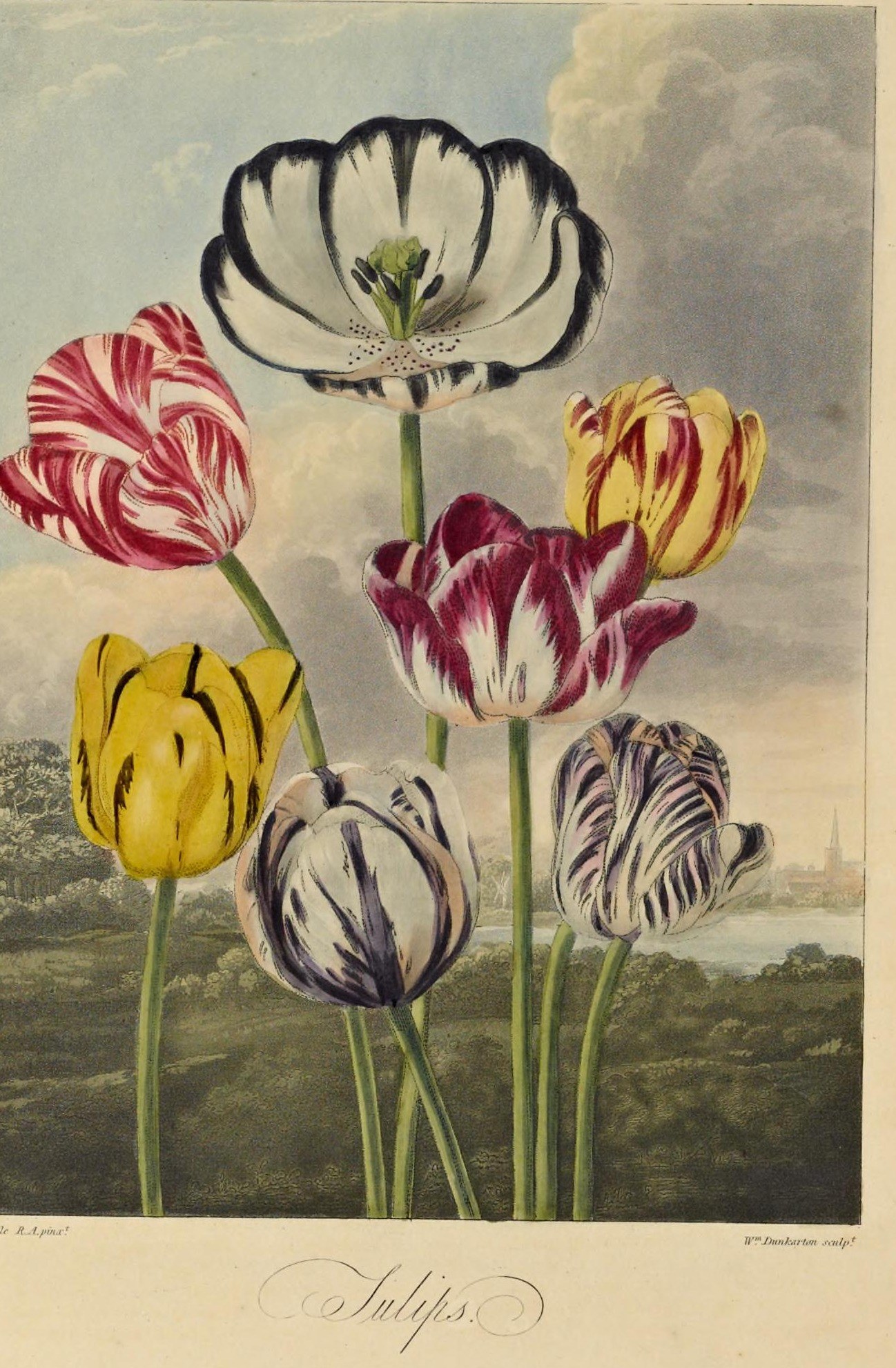
A group of tulips
Part 1 of 6 in The Temple of Flora
Tulipa gesneriana (published as Tulips)
Thornton's group of florists' tulips, flamed and feathered by a virus nobody understood, painted by Philip Reinagle and engraved in mezzotint by Richard Earlom for The Temple of Flora.
- Published
- 1798
- From
- The Temple of Flora
- Drawn by
- Philip Reinagle
- Engraved by
- Richard Earlom
- Technique
- Colour-printed aquatint and mezzotint, finished by hand
- Family
- Liliaceae
- Native to
- Garden tulips, bred in Turkey and Holland from the wild tulips of Central Asia
About the plant
The tulip came to Europe from the gardens of Constantinople in the 1550s, and within a century it had driven the Dutch mad: at the height of the mania in the winter of 1636–37 a single bulb of a striped tulip could change hands for the price of a canal house. What the buyers were paying for was the break, the flames and feathers of a second colour on the petals, which appeared without warning and could not be bred for. It was caused, though nobody knew it for three hundred years, by a virus carried by aphids, which weakened the bulb a little more each year until it died.
Thornton's group shows the florists' tulips of the 1790s, when the English working men's societies of Lancashire and the Midlands judged them on points for the purity of the ground colour and the fineness of the feathering. Philip Reinagle painted the group, and Richard Earlom, the greatest mezzotint engraver of his generation, scraped the plate, which was printed in colour and finished by hand. It was one of the first plates of The Temple of Flora, published in 1798, and one of the few in which Thornton's taste for drama gave way to simple admiration of the flowers.
Bought together
More in the archive