Walter Hood Fitch del. et lith. · Lovell Reeve, London
Week of 24 February 2025
Fairrie's slipper orchid
Part 4 of 9 in Orchid mania
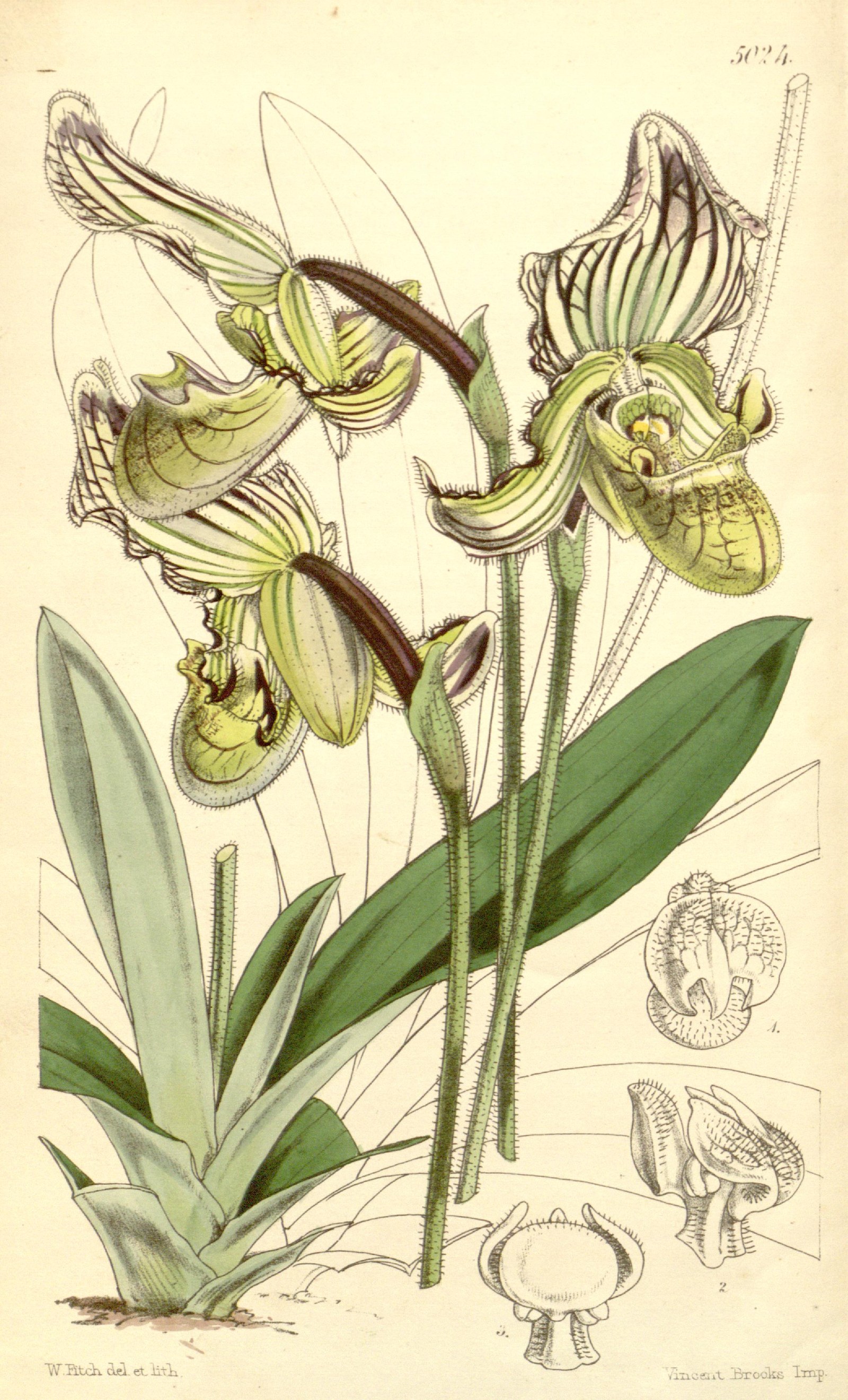
Paphiopedilum fairrieanum (published as Cypripedium fairrieanum)
The 'lost orchid': a slipper orchid that flowered once in Liverpool in 1857, vanished from the wild for fifty years, and had a £1,000 bounty on its rediscovery.
- Published
- Plate 5024, volume 83, 1857
- From
- Curtis's Botanical Magazine
- Drawn by
- Walter Hood Fitch
- Lithograph
- Walter Hood Fitch
- Technique
- Hand-coloured lithograph
- Family
- Orchidaceae
- Native to
- Eastern Himalaya: Bhutan, Sikkim and Arunachal Pradesh
About the plant
In 1857 a few plants of an unknown slipper orchid turned up in a London auction of imported orchids, and one that flowered in the Liverpool collection of a Mr Fairrie caused a sensation: a hooded white sepal pencilled with purple, petals that curled downward like a moustache and were fringed with hairs, and a slipper of olive-green. Hooker named it for its owner and Fitch drew it for this plate. Then the trail went cold. No one knew exactly where it had been collected, the few plants in cultivation dwindled, and for half a century Paphiopedilum fairrieanum was 'the lost orchid'.
By 1904 the nurseryman Frederick Sander of St Albans was offering £1,000, a fortune, to anyone who could rediscover it. It was found the next year in Bhutan, and within two seasons so many had been dug up and shipped that the price fell to shillings. Today it grows on limestone ledges in Bhutan, Sikkim and Arunachal Pradesh and is protected, and the bounty story is told at every orchid show.
The slipper itself is a trap: an insect that falls in can only escape by squeezing out past the pollen masses, carrying them to the next flower.
Bought together
More in the archive