Samuel Holden del. et lith. · Orr & Smith, London
Week of 2 March 2026
Golden angel's trumpet
Part 6 of 6 in Paxton's greenhouse
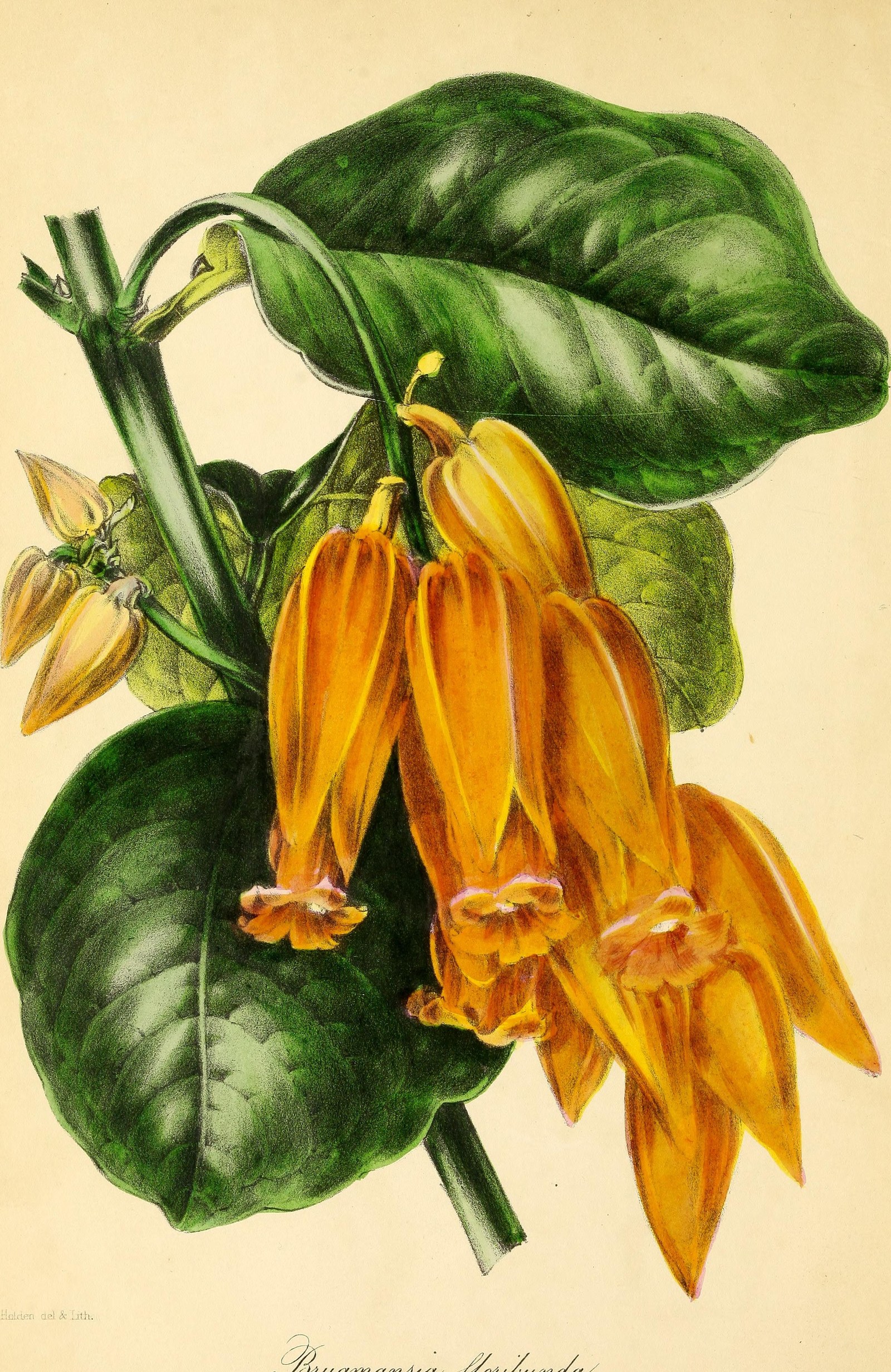
Brugmansia aurea (published as Brugmansia floribunda)
An angel's trumpet from the Andes, its hanging golden flowers a foot long and scented at night, drawn for Paxton's Magazine of Botany in 1842 from the first plant to flower in England.
- Published
- volume 9, 1842
- From
- Paxton's Magazine of Botany
- Drawn by
- Samuel Holden
- Lithograph
- Samuel Holden
- Technique
- Hand-coloured lithograph
- Family
- Solanaceae
- Native to
- The Andes of Colombia and Ecuador
About the plant
The angel's trumpets of the Andes are among the strangest plants of South America: small soft-wooded trees whose enormous hanging flowers, a foot long and golden, white or peach, open at dusk and fill the night with scent for the hawkmoths that pollinate them. They are also deadly, laced with the same alkaloids as deadly nightshade and used for centuries by Andean peoples as a poison and a drug for visions. Nobody has found one growing wild: every angel's trumpet alive, botanists now think, descends from plants cultivated in gardens in the Andes before the Spaniards came, and the wild ancestor is gone.
Paxton's Magazine figured this golden species in 1842, the year it first flowered in England at the Youngs' nursery at Epsom, under the name Brugmansia floribunda; it is now known as Brugmansia aurea. The plate shows a truss of flowers at natural size, with the big soft leaves, and the notes recommend it for the back of a conservatory where it can grow to the roof and hang its trumpets over the path. It will do the same in a sheltered garden in the south of England if it is brought under cover for the winter.
Bought together
More in the archive