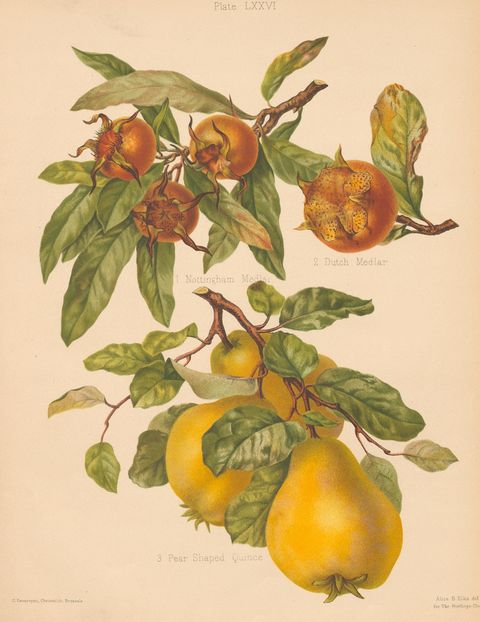
Week of 28 October 2024 · Plate LXXVI
The medlar and the quince
Mespilus germanica and Cydonia oblonga
From £10
Buy
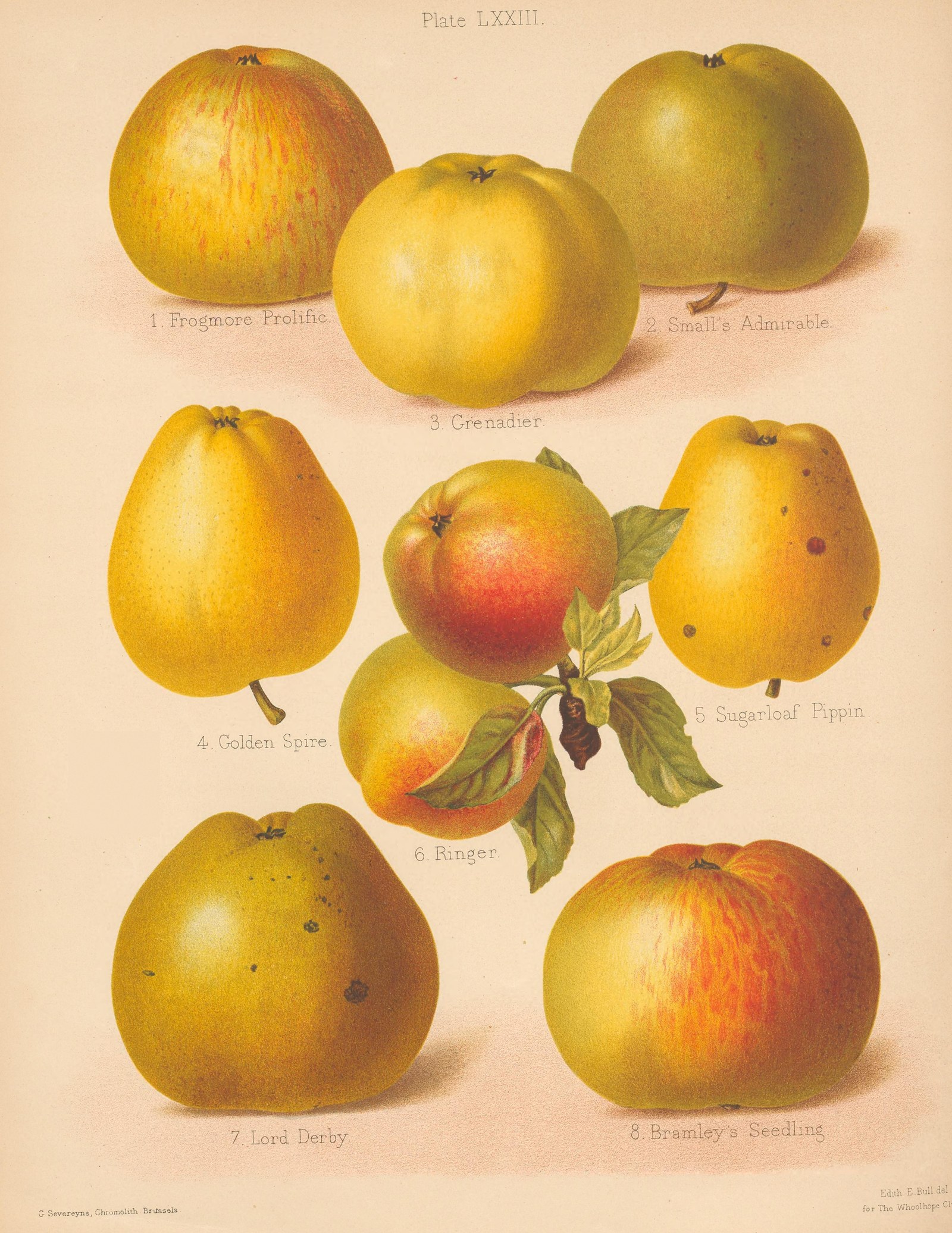
Alice B. Ellis and Edith E. Bull del. · G. Severeyns, Brussels · Jakeman & Carver, Hereford
Week of 21 October 2024
Part 5 of 6 in Apples and pears of Herefordshire
Malus domestica 'Bramley's Seedling'
Bramley's Seedling, the English cooking apple, raised from a pip by a girl in Southwell in 1809 and still growing on its original tree, painted for the Herefordshire Pomona among the culinary apples.
The apple that fills every English pie began as a pip planted by a girl. Around 1809 Mary Ann Brailsford sowed apple seeds in a pot in her garden at Southwell in Nottinghamshire and planted out the seedling that came up; it grew into a tree that bore enormous green apples with a sharp flavour that cooked to a froth. The cottage changed hands, and when a local nurseryman, Henry Merryweather, asked the owner, a butcher named Matthew Bramley, for cuttings in 1856, Bramley agreed on condition that the apple should carry his name. Merryweather sold it from 1865, and the Royal Horticultural Society gave it a first-class certificate in 1883, the year before the Pomona painted it.
It is a triploid, with three sets of chromosomes instead of two, which makes it vigorous, enormous and infertile: a Bramley needs two other apples nearby to set fruit, and in return it bears heavily and keeps until spring. The original tree blew down in a gale in 1900, rooted again from where the trunk touched the ground, and was still bearing in the twenty-first century. Edith Bull painted the fruit for the second volume of the Pomona in 1884, among the culinary apples, when it was still a novelty outside the Midlands.
Week of 28 October 2024 · Plate LXXVI
Mespilus germanica and Cydonia oblonga
Week of 7 October 2024 · Plate XVI
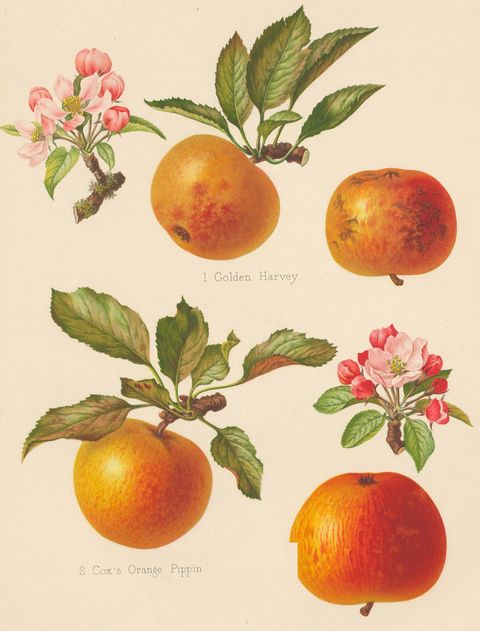
Malus domestica 'Cox's Orange Pippin'