Frederick William Smith del. · Orr & Smith, London
Week of 26 January 2026
Pitcher plant of Ceylon
Part 1 of 6 in Paxton's greenhouse
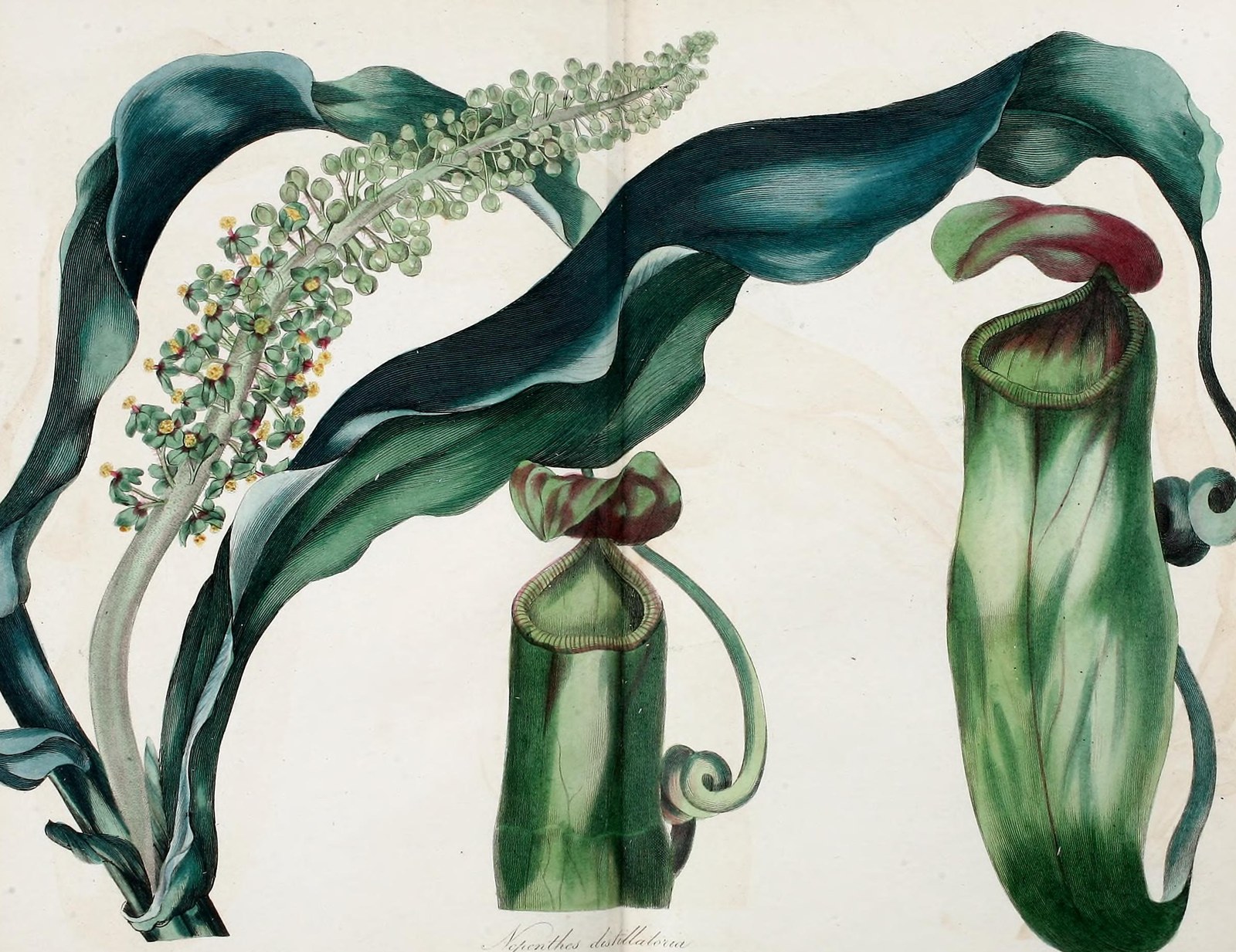
Nepenthes distillatoria
The first tropical pitcher plant known to Europe, with its leaf-tips grown into lidded jugs that drown insects, drawn from the plant in the stove at Chatsworth for Paxton's Magazine of Botany.
- Published
- volume 4, 1838
- From
- Paxton's Magazine of Botany
- Drawn by
- Frederick William Smith
- Technique
- Hand-coloured engraving
- Family
- Nepenthaceae
- Native to
- Sri Lanka
About the plant
Joseph Paxton was the Duke of Devonshire's head gardener at Chatsworth, where he built the Great Stove, the largest glasshouse in the world, flowered the giant waterlily for the first time in Europe and designed the Crystal Palace in a doodle at a railway board meeting. In between he edited a magazine. Paxton's Magazine of Botany ran from 1834 to 1849 with hand-coloured plates of the newest greenhouse plants and practical notes on growing them, written for the gardeners of the great houses who, like him, had come up through the bothy. This plate from 1838 shows one of his own plants.
Nepenthes distillatoria is the pitcher plant of Ceylon, the first of its family that Europe knew: the Dutch had described it under its Sinhalese name, bandura, in 1677, and Linnaeus named the genus in 1753 for the drug in the Odyssey that banished grief. The pitcher is the end of the leaf, its midrib extended into a tendril and then swollen into a lidded jug lined with wax and half full of liquid. Insects attracted by the nectar on the rim slip in, cannot climb out and are digested, and the plant lives on them in soils that have nothing else to give. Paxton's plant at Chatsworth hung its pitchers over the edge of a basket in the stove and flowered in 1837, which no one in England had managed before.
Bought together
More in the archive